Until the last day of work, 03/20/2030until 03/20/203003/20/2030
lastday.at
The last day of work on Earth has a date, set by lastday.at: March 20, 2030. Here you will find out why that date, and how we got here.
Machines that work for us are a very old idea. Aristotle imagined tools that would make slaves unnecessary, and Heron built automata in Alexandria almost 2,000 years ago. Below is the timeline of those machines, from the water clock of ancient Egypt to artificial intelligence and humanoid robots, and of the ideas of income for all that grew alongside them. Scrolling down moves forward in time; the space between events shows the size of each leap.
Sand and water
Scribes, builders, the first strike and the first machines that work on their own.
c.3200BC
Writing is born to count goods
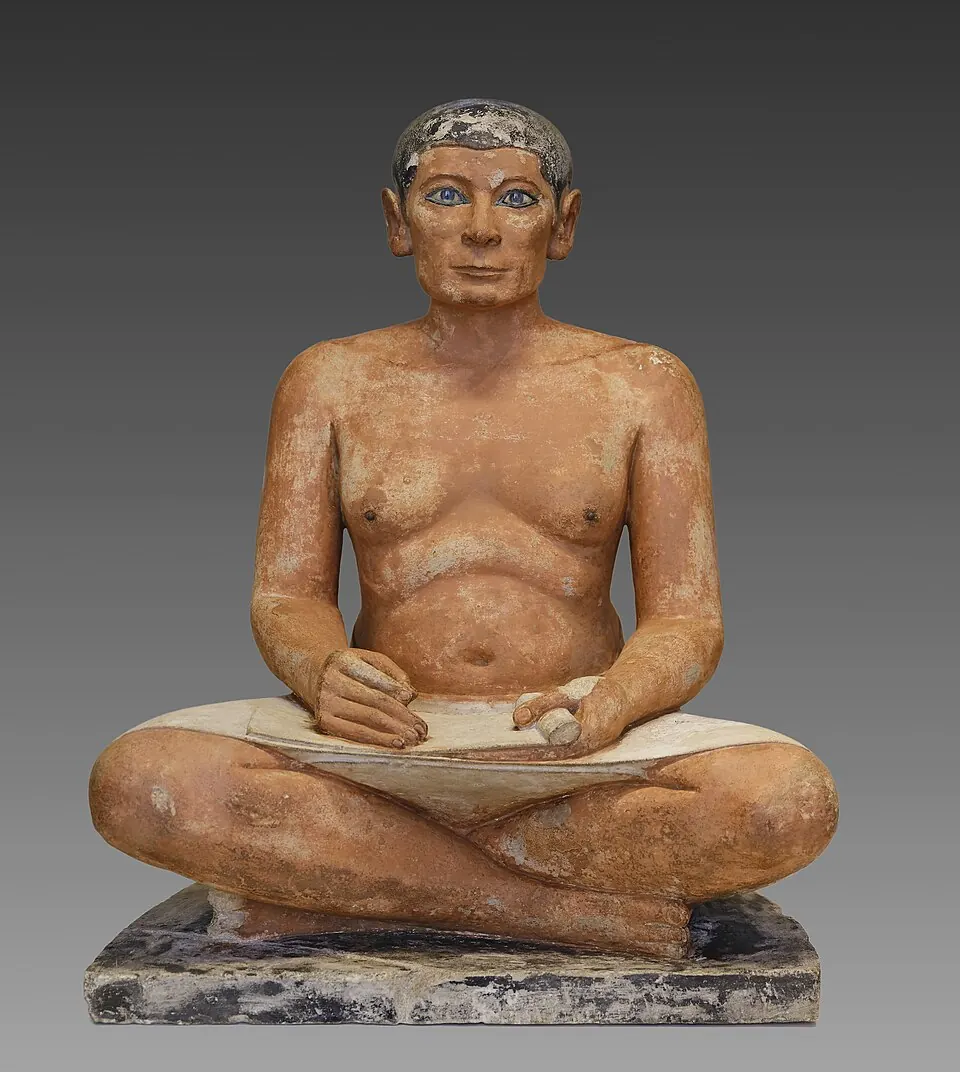
In Egypt, small labels from tomb U-j at Abydos record goods and where they came from. In Uruk, in Mesopotamia, the first tablets count rations of grain, fish and animals. Writing is born as accounting, and the scribe becomes the first office profession: cognitive work that AI would begin to do 5,000 years later.
The Seated Scribe, Egypt, c. 2600–2350 BC. Louvre Museum. CC0
c.2560BC
The pyramid was built by crews, not by slaves
In the Giza builders' village, archaeologist Mark Lehner found bakeries and enough cattle bones to feed thousands of people with meat. Rotating crews, with names like "Friends of Khufu", carried out compulsory labor owed to the state. "They were not slaves," says Lehner.
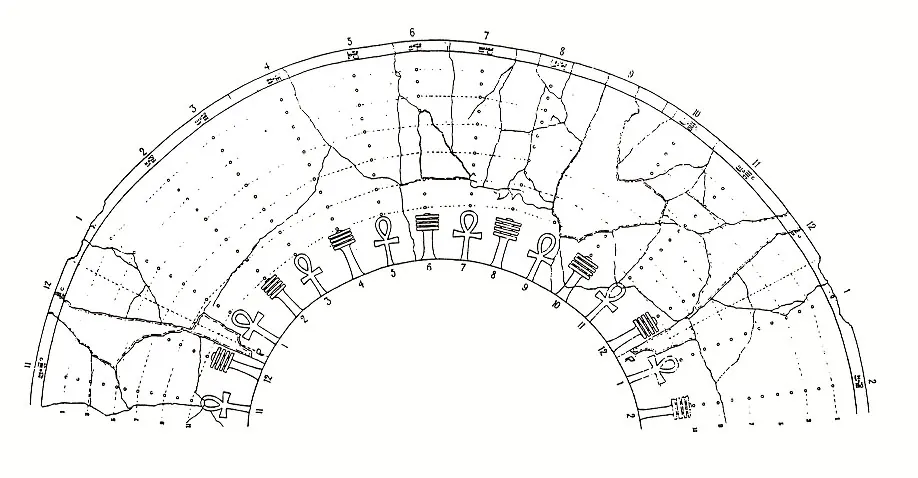
Made of alabaster in the reign of Amenhotep III, it is the oldest surviving water clock. Water drains through a hole, and twelve columns of marks, one for each month, show the hours of the night for the priests' rites. Measuring time no longer depends on looking at the sky.
Inner scales of the Karnak clepsydra, drawn by Ludwig Borchardt in 1920. Public domain
c.1157BC
The first recorded strike in history
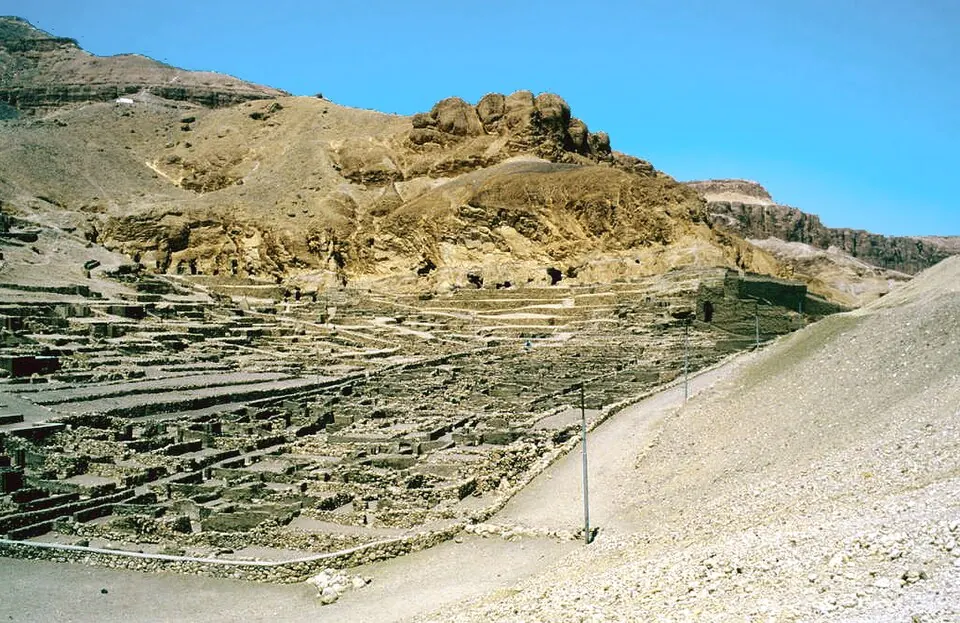
In year 29 of Ramesses III, the royal tomb builders of Deir el-Medina lay down their tools because their grain rations have not arrived. They march past the guard posts shouting "We are hungry!" The scribe Amennakht records it all on a papyrus, now in the Egyptian Museum of Turin.
Ruins of the workers' village of Deir el-Medina, in Luxor. CC BY-SA 4.0
c.350BC
Aristotle imagines tools that work on their own
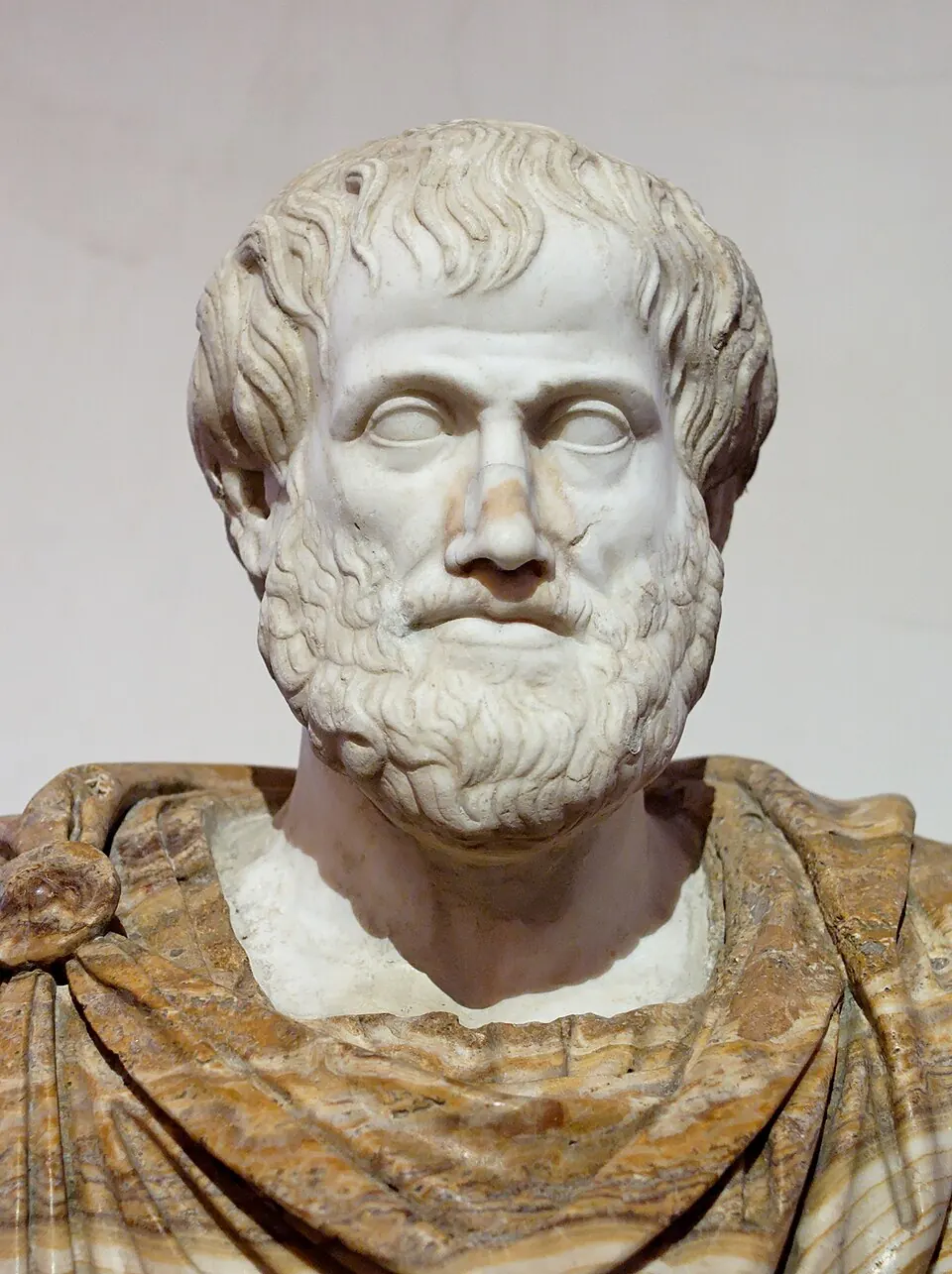
In the "Politics", Aristotle writes that if every tool did its own work, "if the shuttles wove and the plectrums played the harp by themselves", master craftsmen would need no assistants, and masters no slaves. It is the first time anyone links automation to the end of forced labor.
Bust of Aristotle, Roman copy. Palazzo Altemps, Rome. Public domain
c.270BC
The float that invented automatic control
In Alexandria, a float valve starts keeping the water level in clocks constant: when the level drops, it opens; when it rises, it closes. Attributed to Ctesibius, it is considered the first known feedback mechanism, the same principle that today keeps a robot on its feet.
Water clock from the reign of Ptolemy II (285–246 BC), from the time of Ctesibius. Oriental Institute, Chicago. CC0
c.100BC
The Antikythera mechanism
Found in 1901 in a shipwreck near the Greek island of Antikythera, this bronze device calculated the positions of the Sun and the Moon, the lunar phases and eclipses. What survives is 82 fragments and about 30 gears. It is the oldest known analog computer.
Main fragment, National Archaeological Museum, Athens. CC BY 2.5
c.62AD
Hero and the first vending machine
Hero of Alexandria describes the aeolipile, a sphere spun by steam, and a machine that releases a measure of water when a coin is inserted, the first known vending machine. His mechanical theater staged a play of almost ten minutes on its own, driven by cords, knots and gears.
The aeolipile, Hero's steam sphere (illustration). Public domain
c.75AD
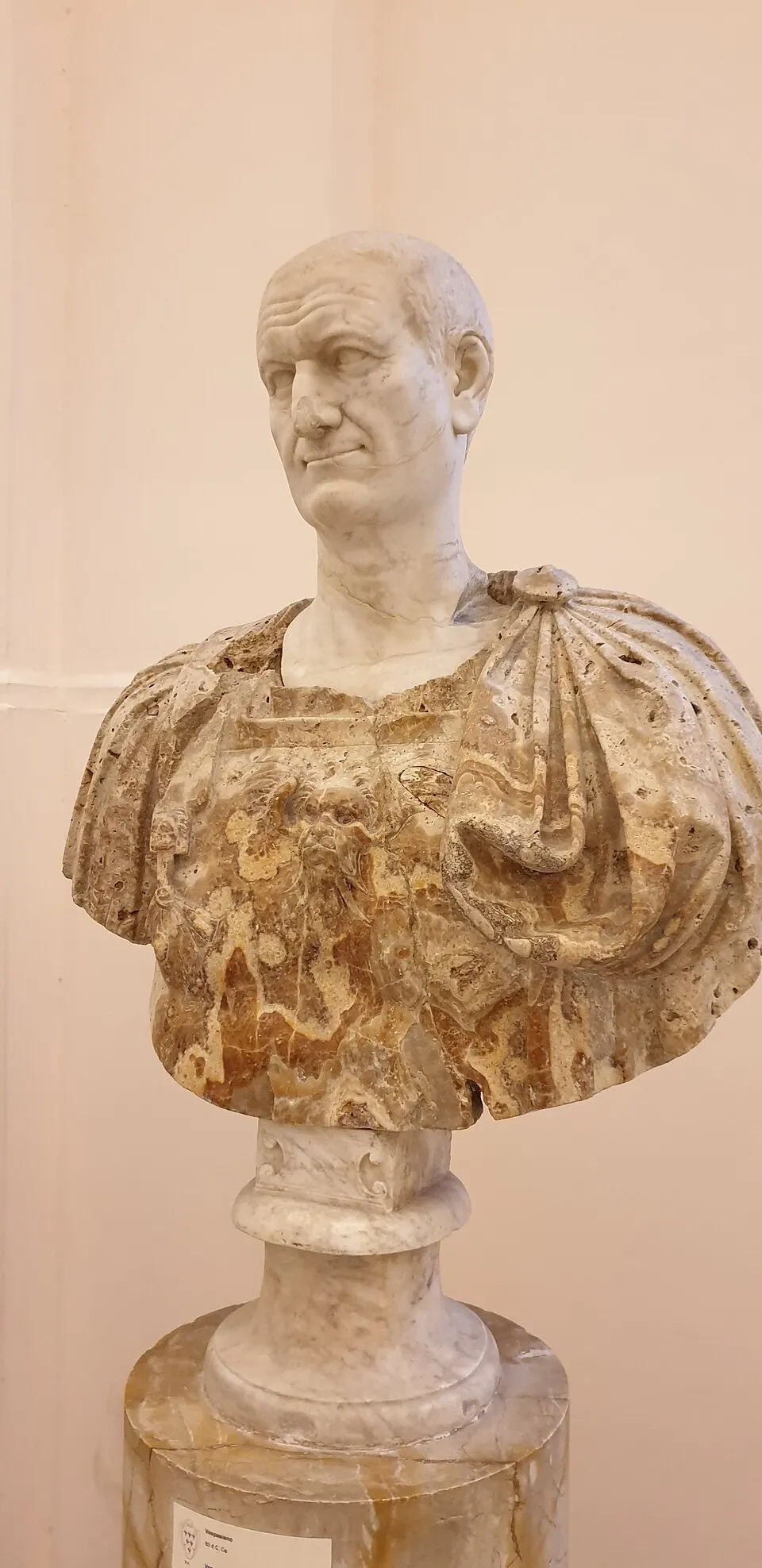
Vespasian turns down a machine to save jobs
An engineer offers the emperor a cheap way to haul heavy columns up to the Capitol. Vespasian rewards the invention but refuses to use it: "Let me feed my poor common people." It is one of the oldest records of the dilemma between machines and jobs.
Clocks on towers, the printing press replacing copyists and the first ideas of a living for everyone.
1206
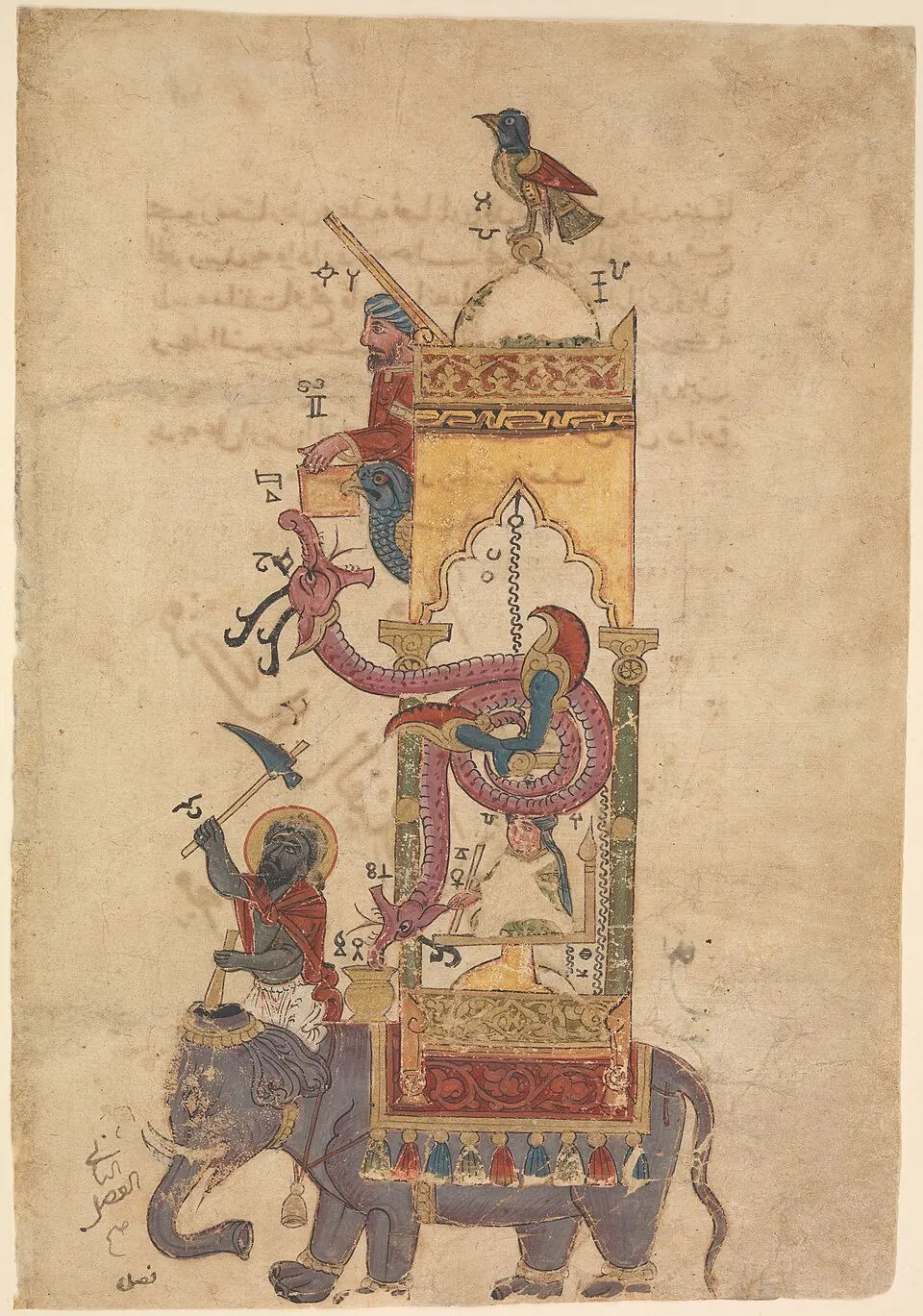
Al-Jazari and the 50 ingenious machines
The engineer Ismail al-Jazari completes "The Book of Knowledge of Ingenious Mechanical Devices", with instructions for building 50 machines. Among them are a boat with four automatic musicians and an automaton that served water for washing hands. A mechanical servant, eight centuries before household robots.
The elephant clock, a leaf from a copy of al-Jazari's book. Metropolitan Museum of Art. CC0
c.1300
Mechanical clocks go up the towers
Around 1275, the escapement appears, making possible the first mechanical clocks, installed in towers to ring bells. In 1336, Milan has the first known clock to strike every hour. Between 1371 and 1380, more than 70 European cities install public clocks: the day comes to be measured in equal hours.
Prague astronomical clock, installed in 1410. CC BY-SA 4.0
c.1440
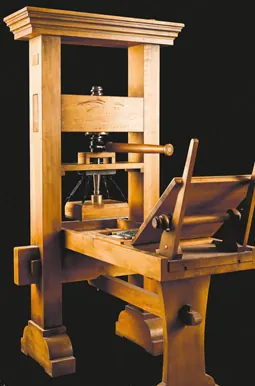
Gutenberg's press replaces the copyists
In Mainz, Johannes Gutenberg develops the movable-type printing press. By 1500, about 270 European cities are already printing, and more than 20 million copies have come off the presses. In 1492, the abbot Johannes Trithemius still argues that monks should keep copying books by hand.
Replica of the press used by Gutenberg. CC BY-SA 4.0
c.1495
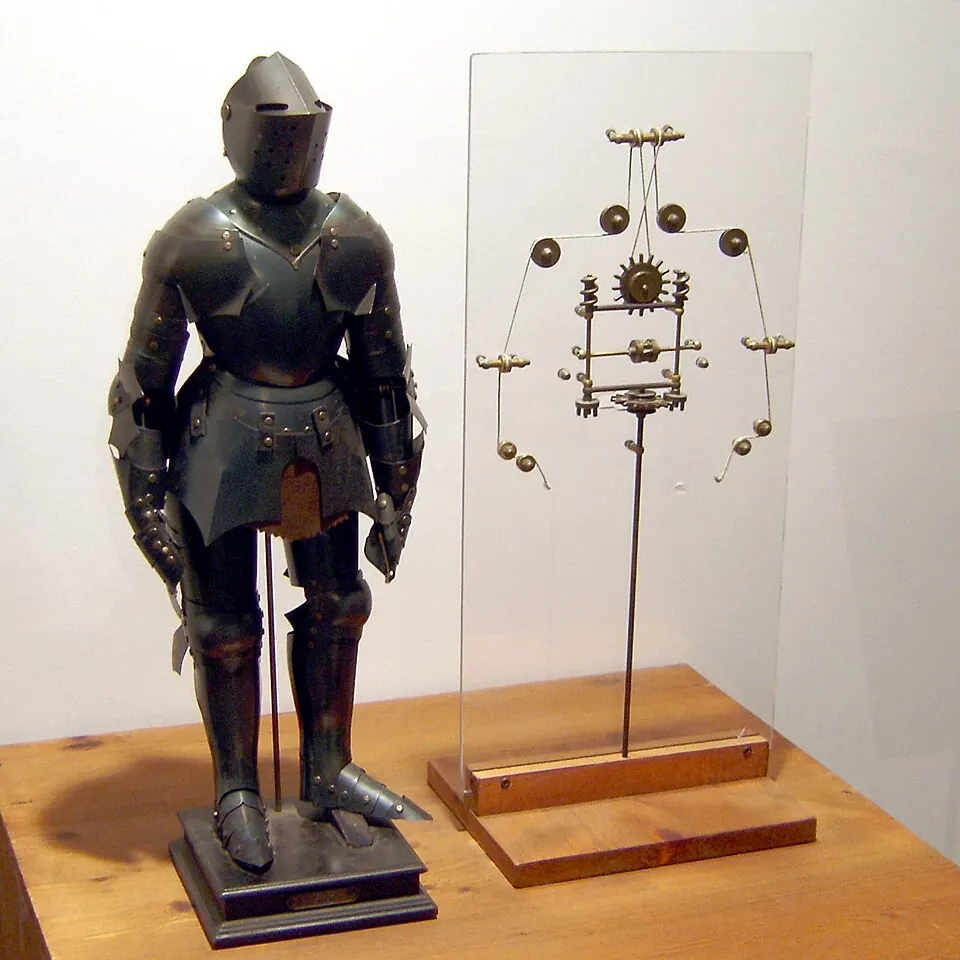
Leonardo's mechanical knight
In Milan, Leonardo da Vinci designs a knight in armor driven by cables and pulleys, able to sit up, move its arms and open its jaw. The drawings were only recognized in the 1950s. In 2002, engineer Mark Rosheim built a version that works.
Model of Leonardo's robot built from his drawings. Public domain
1516
Utopia: provide a living instead of hanging
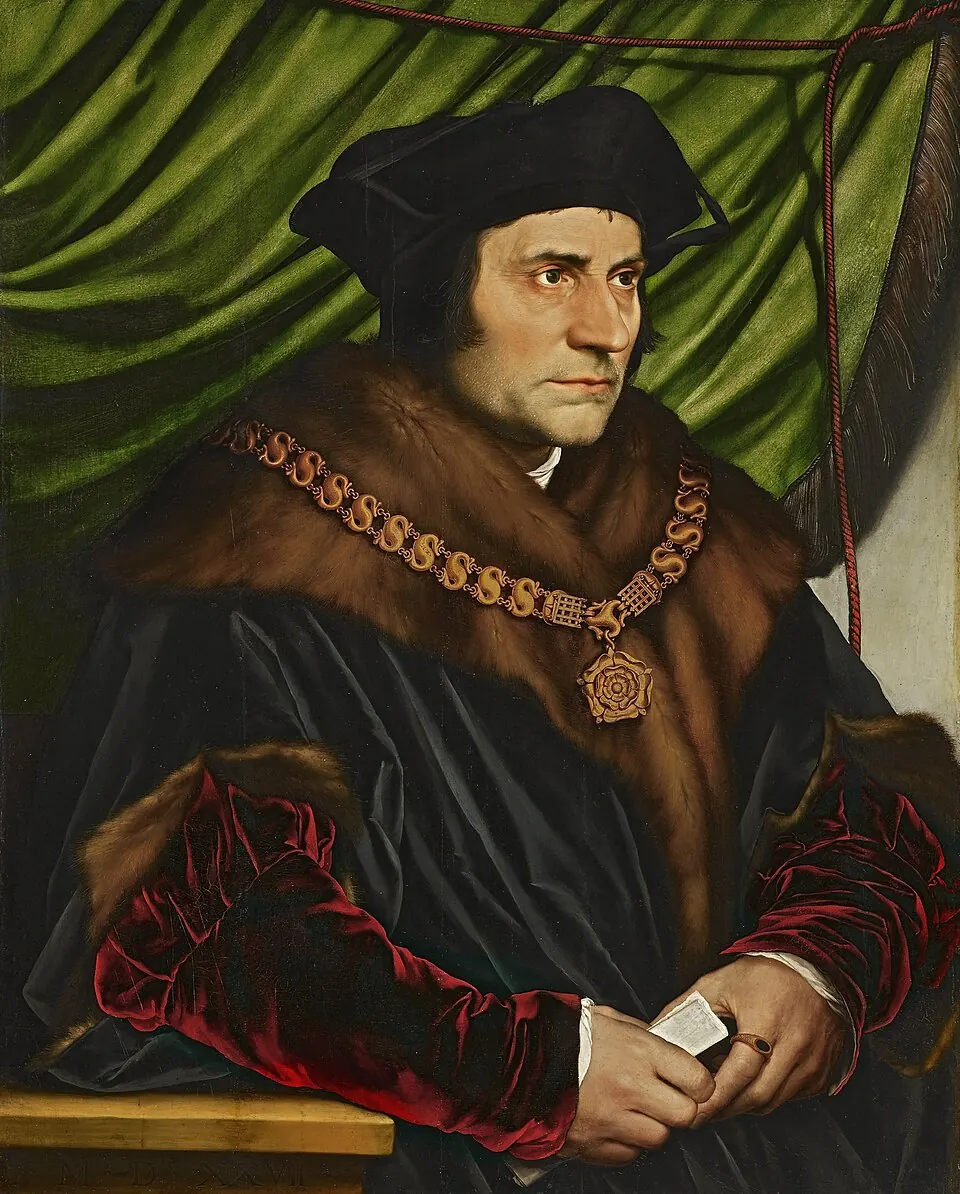
In "Utopia", Thomas More has a traveler criticize the gallows for thieves in England: it would be far better to provide everyone with a means of living, so that no one would be driven by necessity to steal. It is the first seed of the idea of a minimum income, still tied to compulsory work.
Thomas More, by Hans Holbein the Younger (1527). Public domain
1526
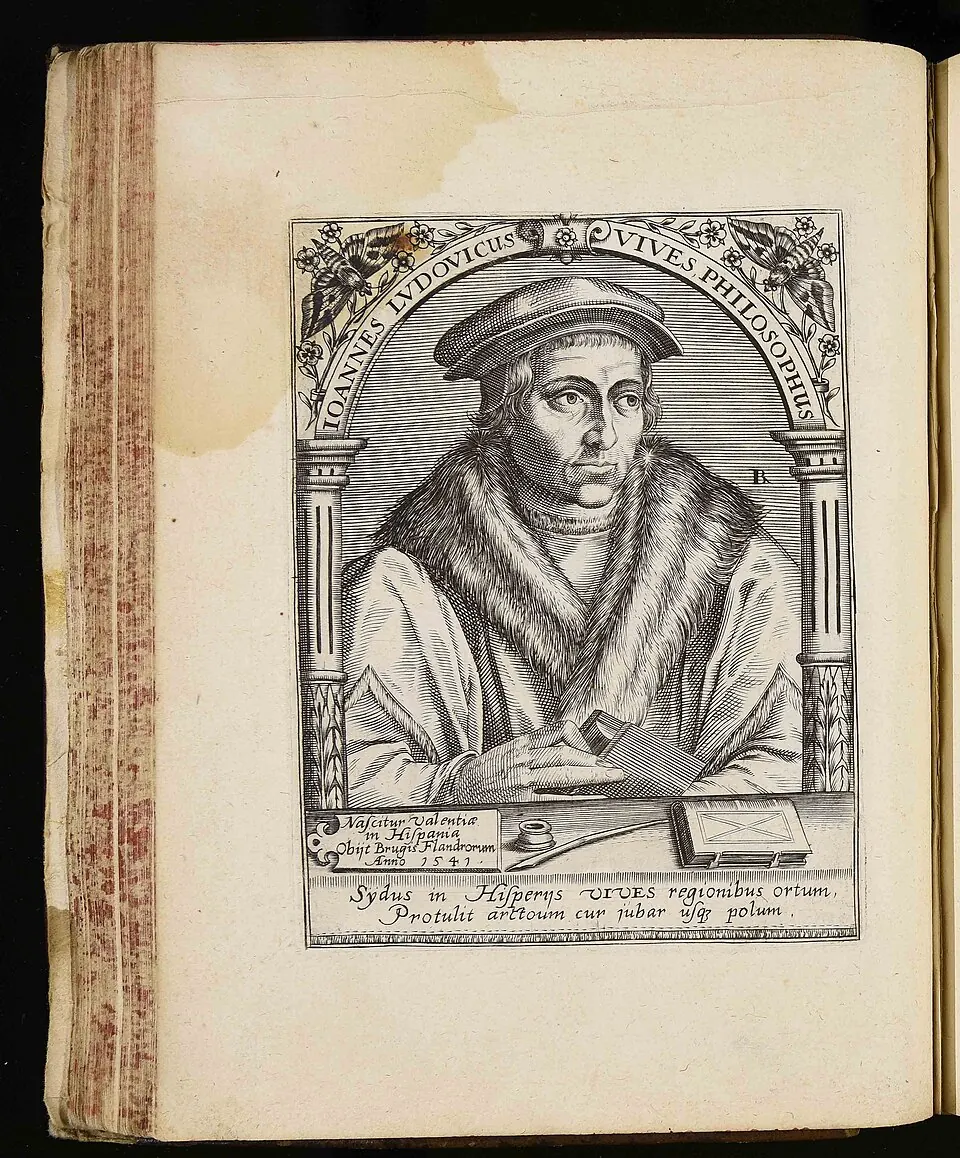
Vives proposes that the city support the poor
At the request of the city of Bruges, the humanist Juan Luis Vives publishes "De Subventione Pauperum": the municipal government should guarantee the subsistence of its poor residents, as long as those who are able work. The book becomes the basis of urban poor relief in 16th-century Europe.
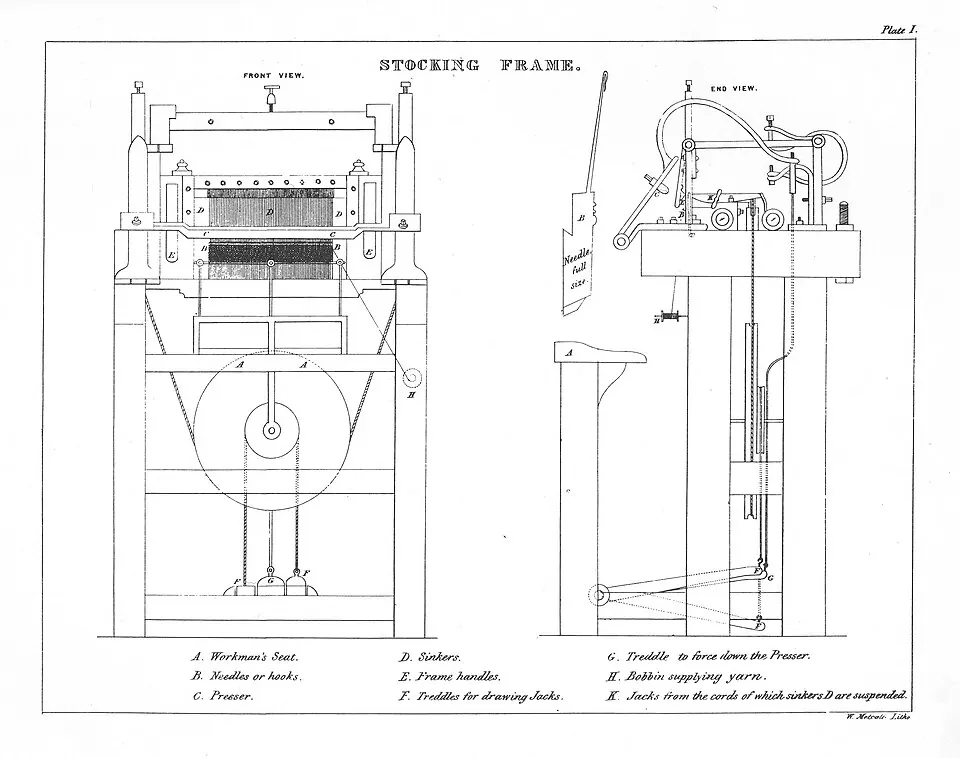
The clergyman William Lee invents the mechanical stocking frame. Tradition has it that Elizabeth I refused the patent, fearing the machine would ruin her "poor subjects" by depriving them of employment and "making them beggars". Historians treat the line as a 19th-century legend, but it sums up a fear that would return many times.
Technical drawing of William Lee's stocking frame. CC0
1642
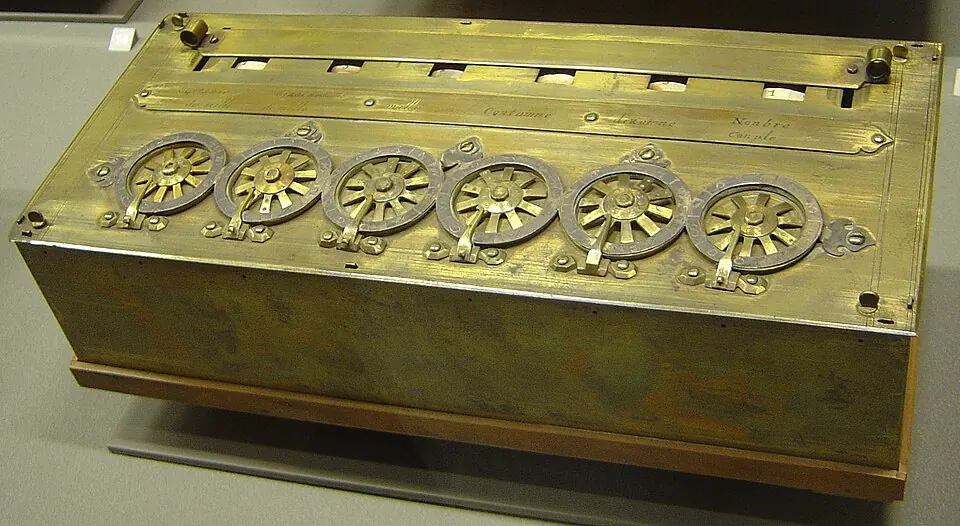
The Pascaline does the tax sums
At 19, Blaise Pascal invents an adding machine to ease the work of his father, a tax supervisor in Rouen. He made about 50 prototypes and some 20 machines by 1654, when production stopped because it was too expensive. Nine survive.
Pascaline at the Musée des Arts et Métiers, in Paris. CC BY-SA 3.0
Steam and factories
Smashed machines, eight-hour days, the assembly line and Keynes’s promise for 2030.
1769
Watt and the efficient steam engine
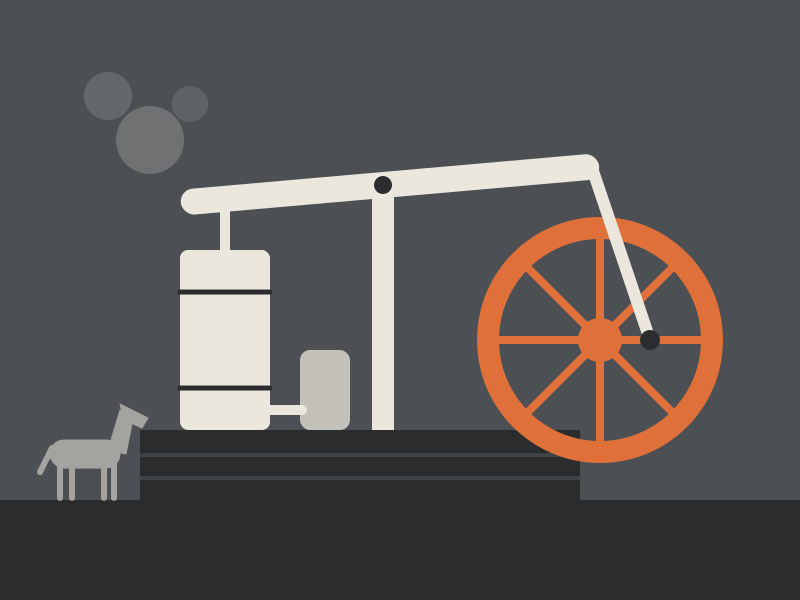
James Watt patents the separate condenser, which makes the steam engine burn far less coal than Newcomen's. From 1781, a system of gears lets it drive factory machines far from rivers. Watt also creates the unit that compares the machine to the animal: horsepower.
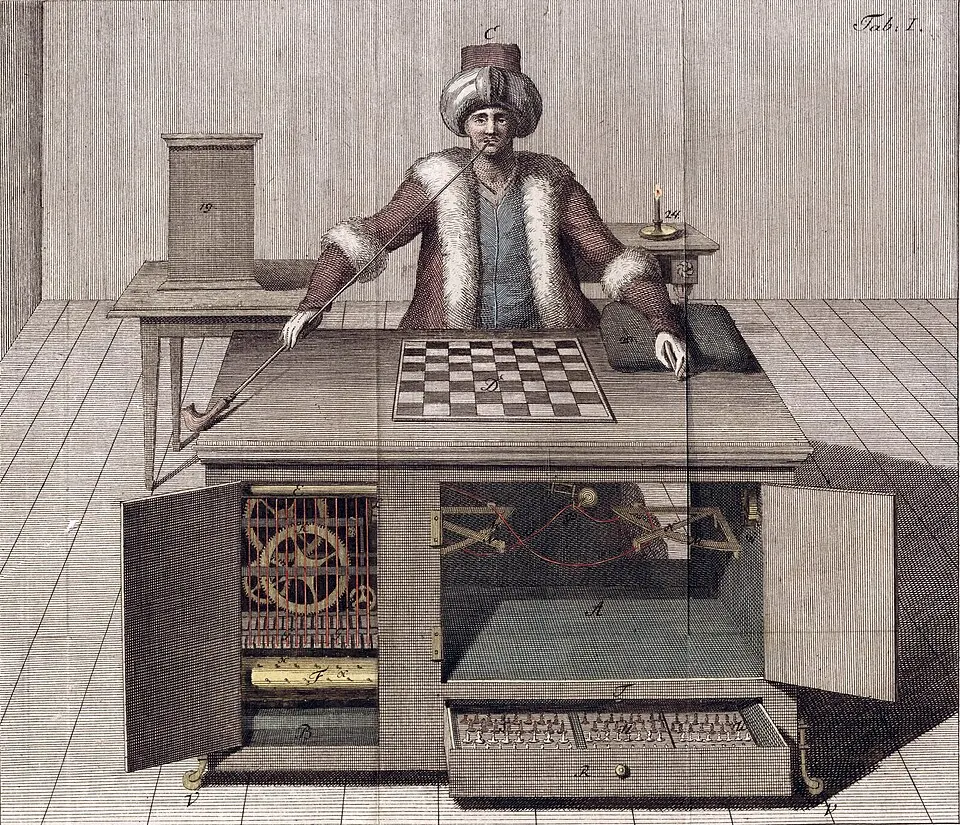
In Vienna, Wolfgang von Kempelen presents an automaton that plays chess. In fact, a chess player hidden in the cabinet moves the pieces. The Turk takes on Benjamin Franklin and Napoleon and is only destroyed in a fire in 1854. Today Amazon uses its name for a human labor service that feeds AI systems.
Engraving by Joseph Racknitz (1789) with his theory of where the player hid. Public domain
1771
Cromford, the factory that never stopped
In Cromford, England, Richard Arkwright opens the first water-powered cotton spinning mill. From 1772 it runs day and night, in two 12-hour shifts. It starts with about 200 workers, mostly women and children, some of them seven years old. The model of the modern factory is born.
The first building of the Cromford mill, from 1771. Public domain
1774
The Writer, a programmable automaton
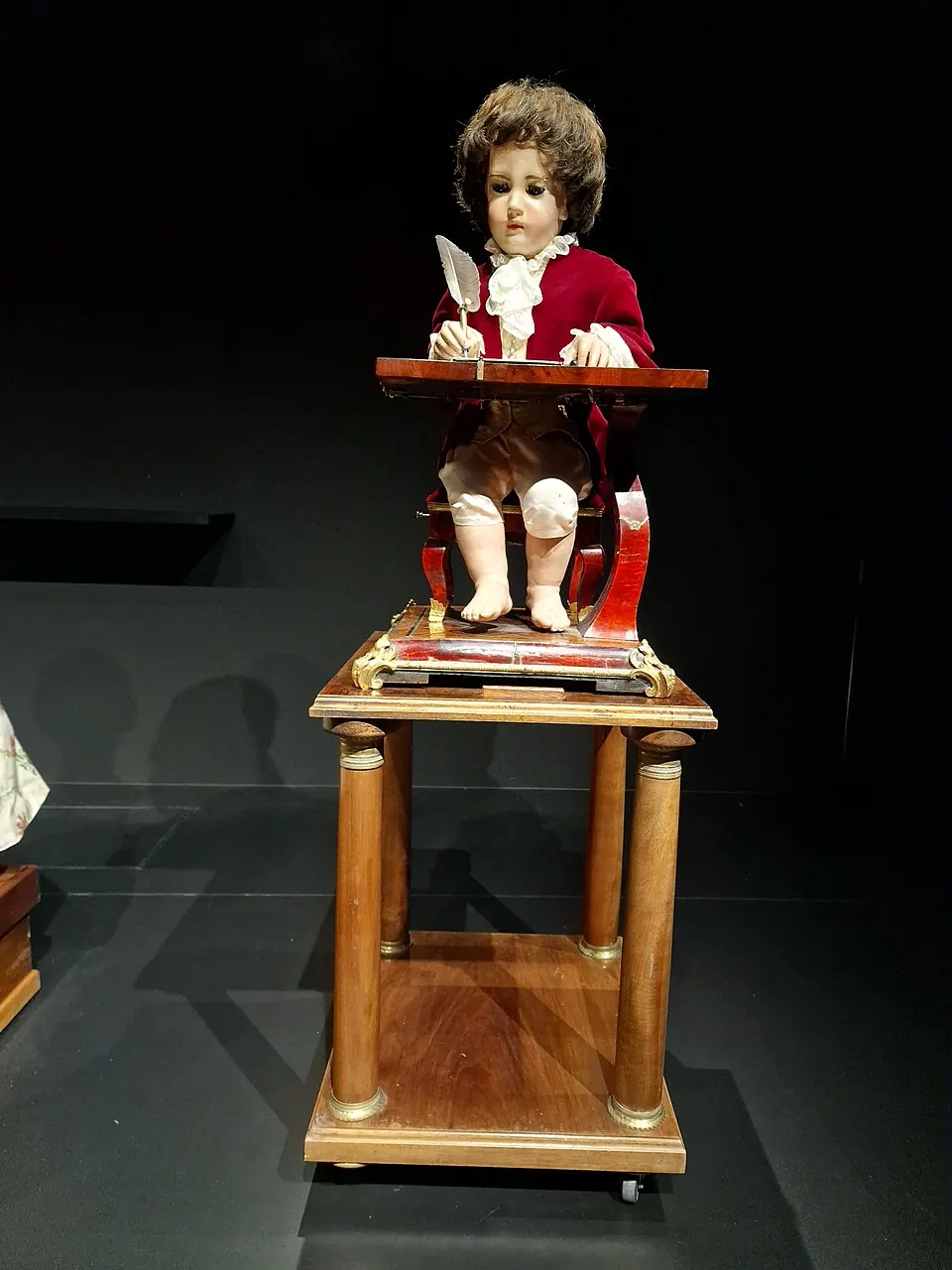
The Swiss watchmakers Pierre and Henri-Louis Jaquet-Droz finish three automata. The Writer, a wooden boy, writes with a quill any text of up to 40 letters, programmed on a wheel. It was advertising to sell watches to the nobility, and it still works today in Neuchâtel.
The Writer, at the Musée d’art et d’histoire de Neuchâtel. CC BY-SA 4.0
1776
Adam Smith and the pin factory
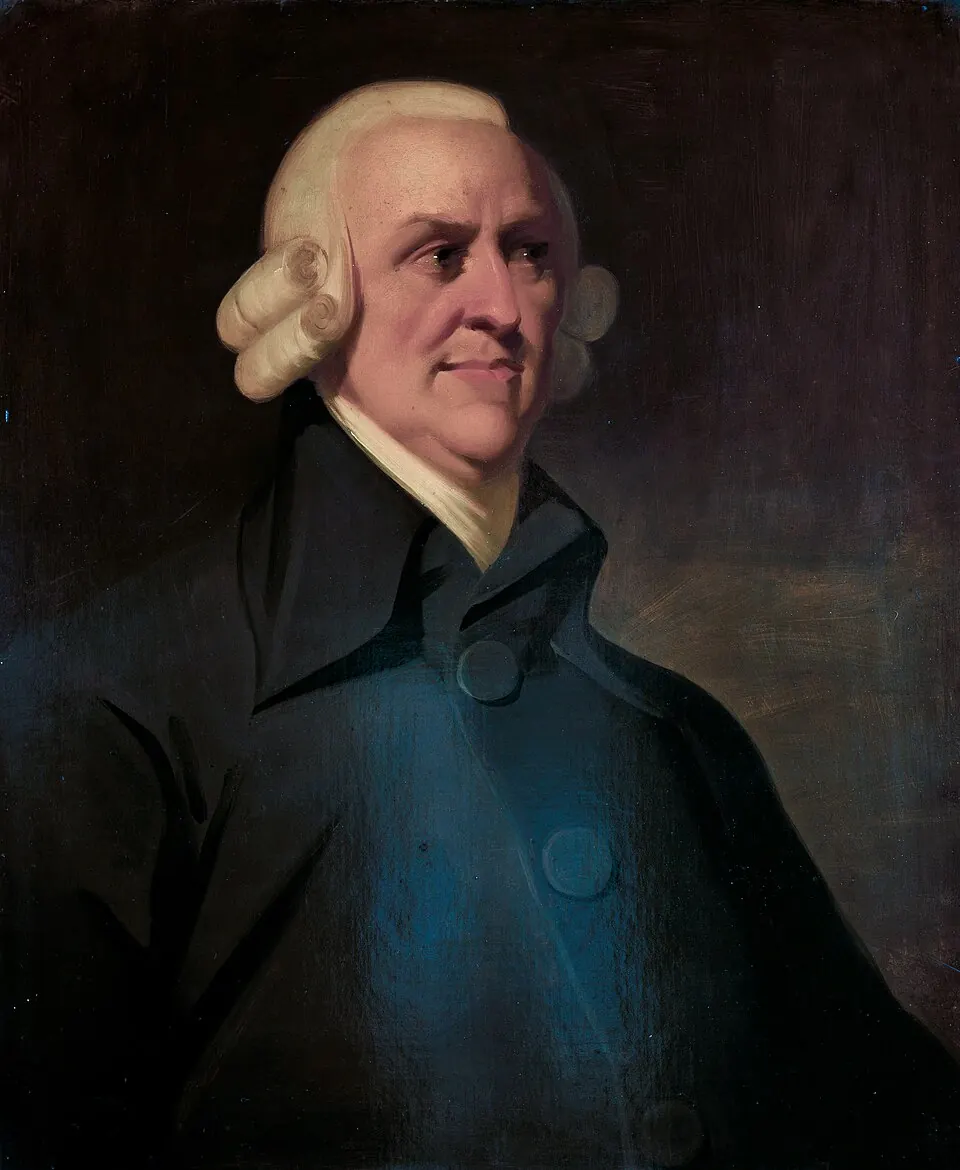
In "The Wealth of Nations", Adam Smith describes a workshop where ten men, divided across about 18 operations, make more than 48,000 pins a day. Alone and untrained, he says, each of them might not make even one. Breaking work into simple steps is the first step toward handing it over to machines.
Adam Smith, portrait by an unknown artist (c. 1800). Public domain
1795
Speenhamland: income top-ups tied to the price of bread
Magistrates meeting at an inn in Speenhamland, England, draw up a table to top up wages according to the price of bread and the size of the family. With bread at 1 shilling, a man is entitled to 3 shillings a week, plus 1 shilling and 6 pence for each dependent.
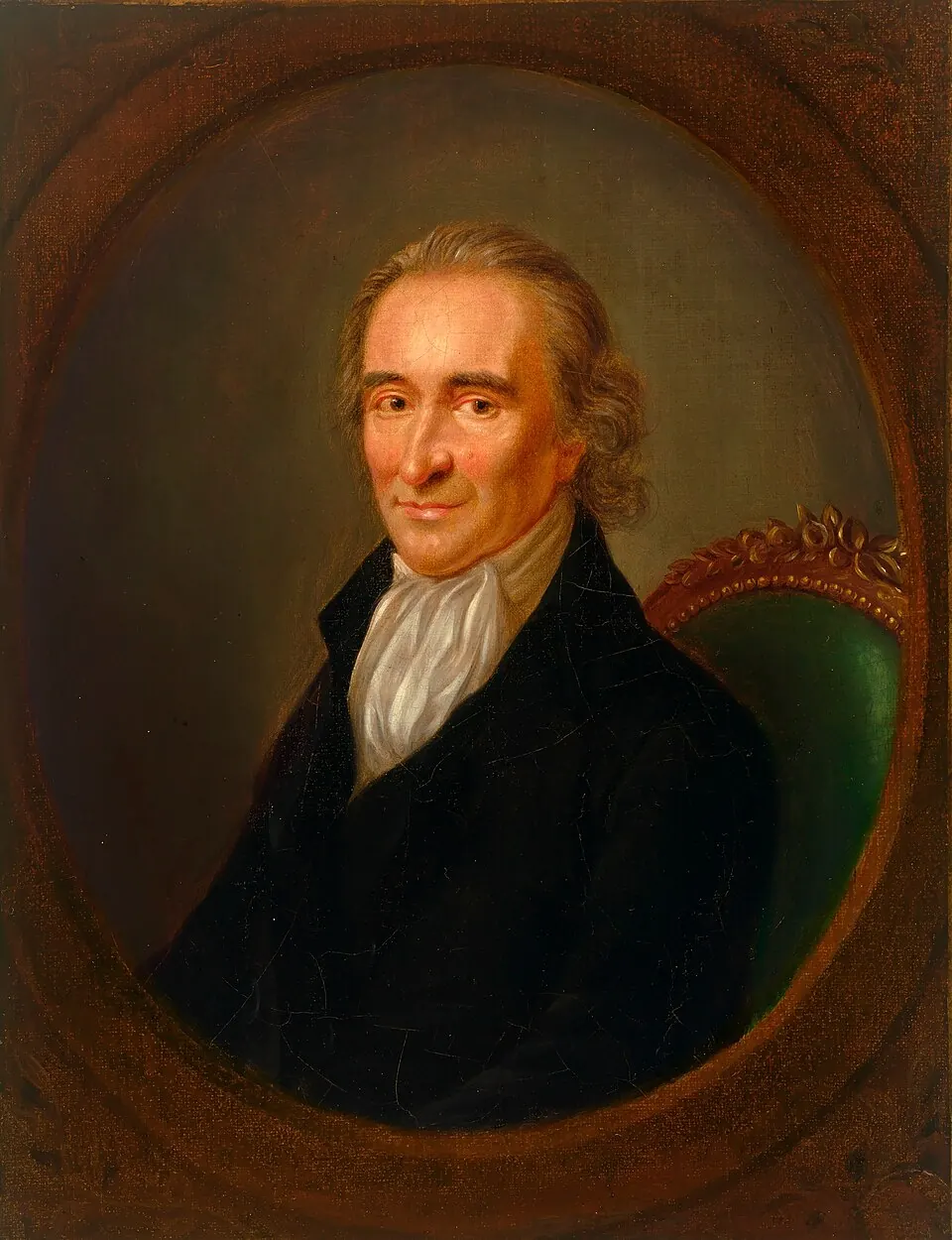
In "Agrarian Justice", Thomas Paine proposes a national fund paid for by a tax on inheritances. Every person, rich or poor, would receive £15 at age 21 and £10 a year from age 50, as compensation for the private ownership of land. Universal and unconditional.
Thomas Paine, by Laurent Dabos (c. 1792). Public domain
1804
Jacquard's loom reads punched cards
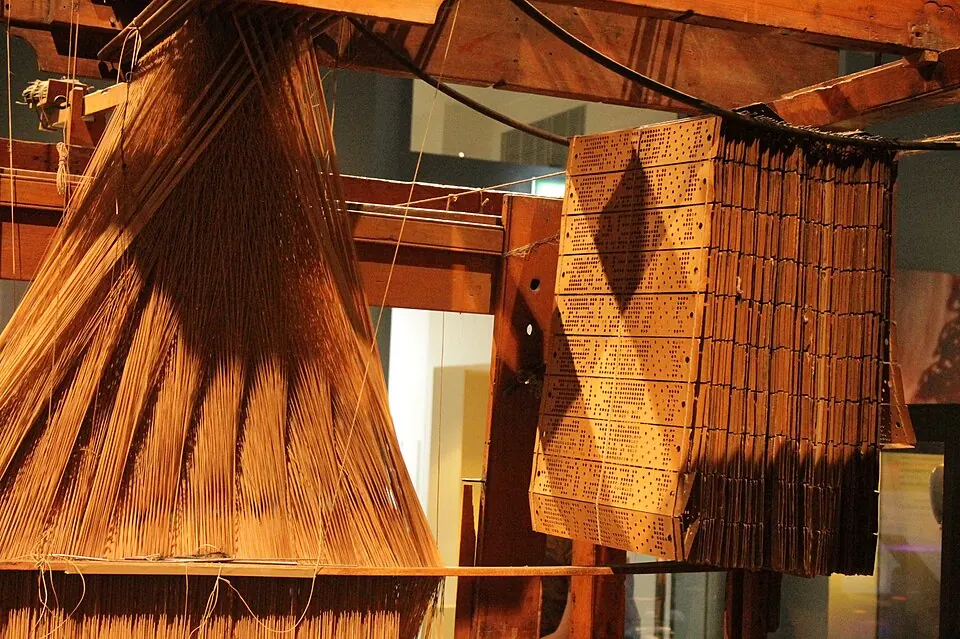
Joseph-Marie Jacquard completes a loom that weaves complex patterns by following a chain of punched cards, like a program. Weavers in Lyon, afraid of losing their livelihood, force him to flee. When he dies, in 1834, there are more than 30,000 of these looms in Lyon alone.
Jacquard loom with its punched cards. National Museum of Scotland. CC BY-SA 4.0
1811
The Luddites smash machines
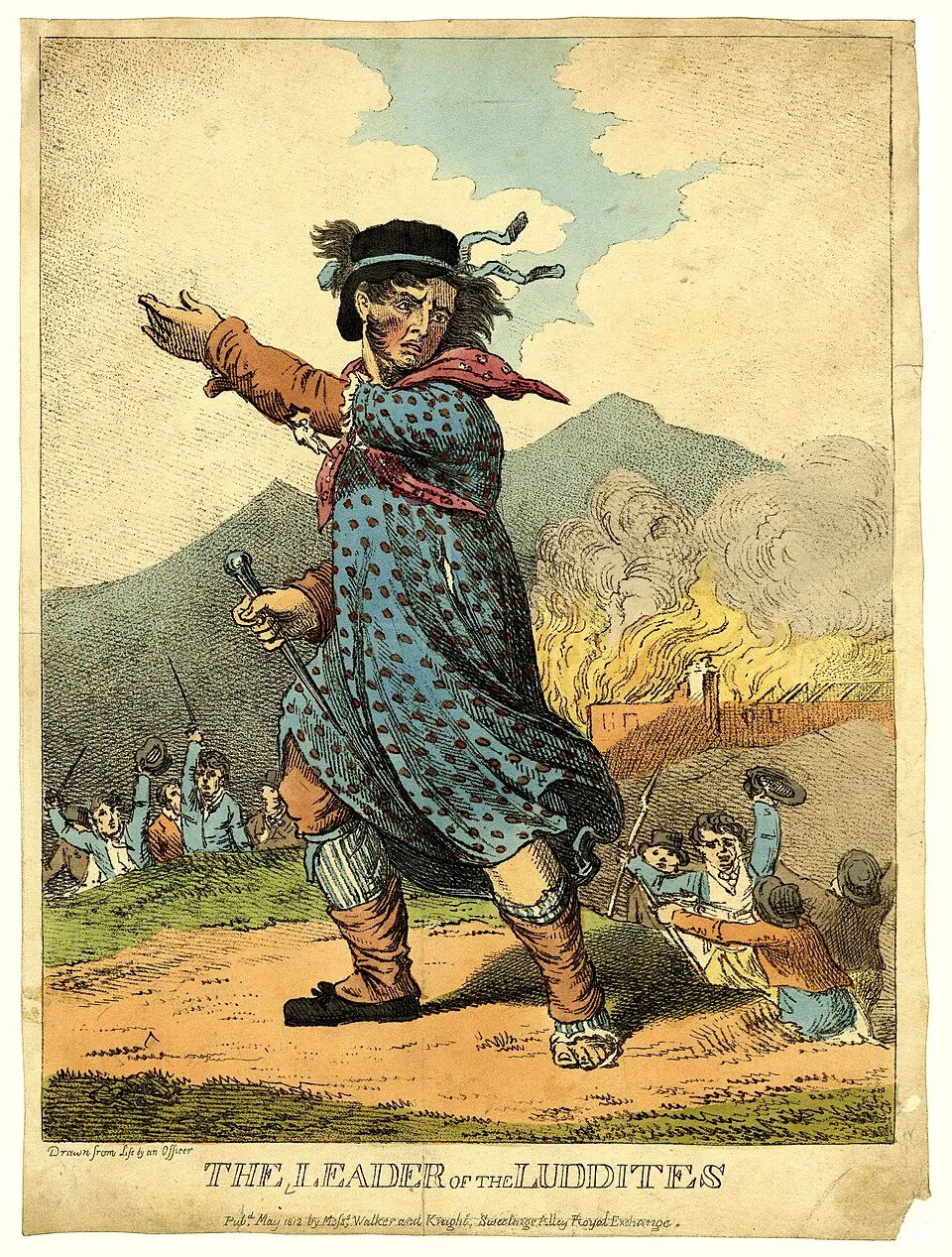
Near Nottingham, the Luddite attacks begin on textile machines used to push down wages. The target was the use of machines against workers, not the technology itself. The government deploys about 12,000 soldiers and, in 1812, makes machine breaking a crime punishable by death.
"The Leader of the Luddites", engraving from 1812. Public domain
1817
Eight hours of work, eight of leisure, eight of rest
The industrialist Robert Owen launches the slogan that becomes a banner of the labor movement. The eight-hour day would only become an international standard a century later, in 1919, with the first ILO convention.
In the third edition of his "Principles", the economist David Ricardo adds the chapter "On Machinery" and changes his mind: replacing human labor with machines is often "very injurious to the interests of the class of labourers."
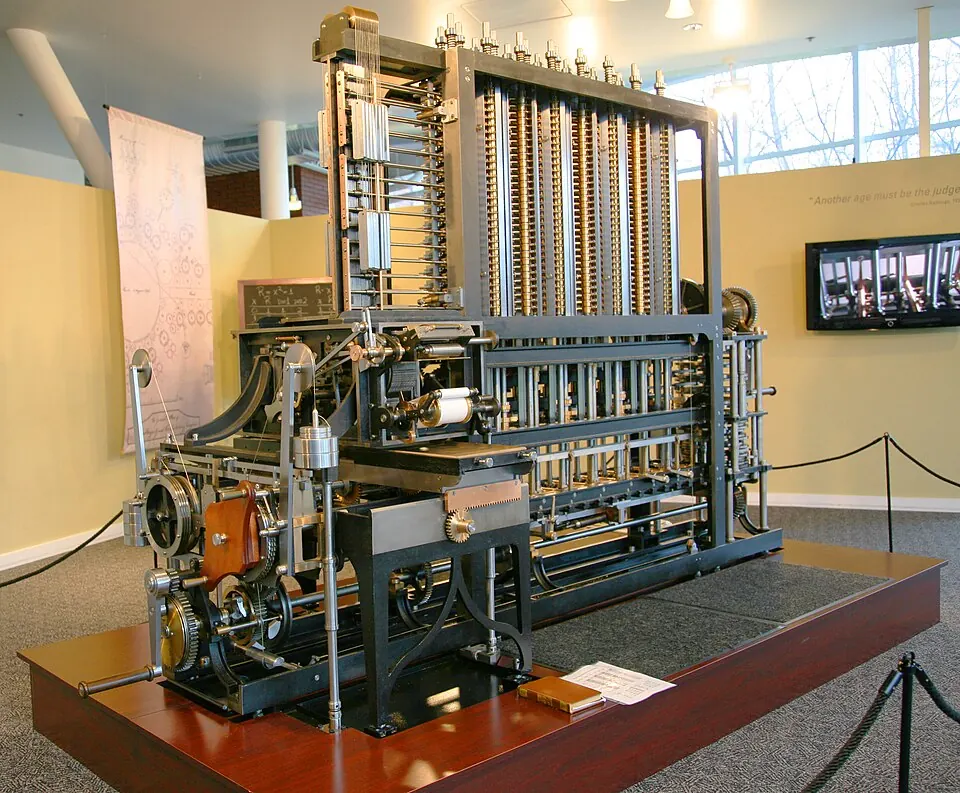
Charles Babbage presents the Difference Engine, which would calculate and print tables without human error. The British government spends more than £17,000 before giving up. In 1837 he describes the Analytical Engine, programmable with cards like Jacquard's. Neither was completed in his lifetime.
Difference Engine No. 2, built from Babbage's original drawings. CC BY 2.0
1830
The Swing Riots against threshing machines
Farmworkers in the south and east of England destroy the threshing machines that were taking their jobs, signing letters as a fictional "Captain Swing". Nearly 2,000 people are tried: 252 sentenced to death, 19 hanged and 481 deported to Australia.
The British Factory Act bans the employment of children under 9 in textile mills. Children aged 9 to 13 are limited to 48 hours a week and must get two hours of schooling a day. The act also creates factory inspectors.
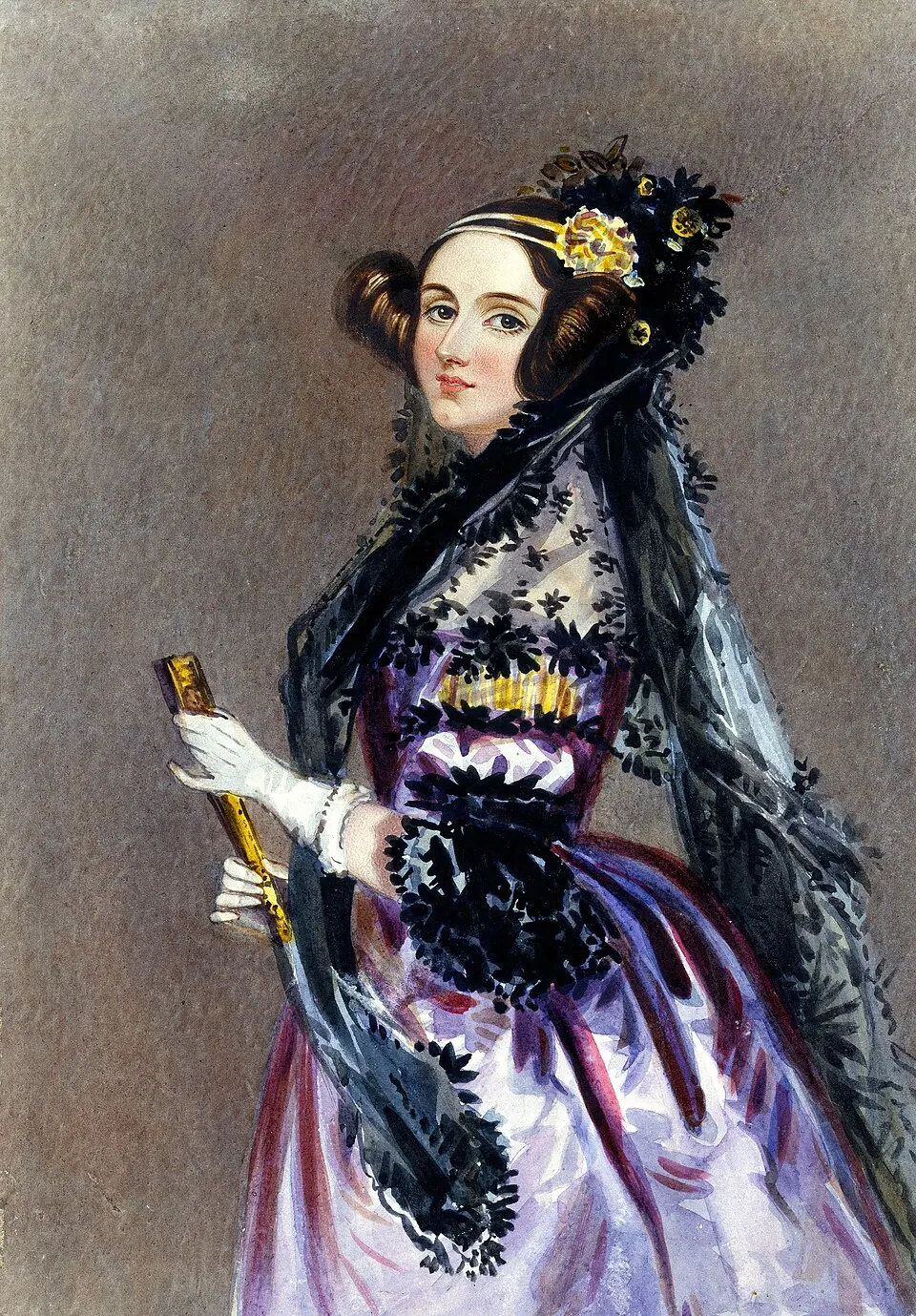
While translating an article about the Analytical Engine, Ada Lovelace adds seven notes. Note G sets out a method for calculating Bernoulli numbers, regarded as the first complete program. And a warning still debated today: "The Analytical Engine has no pretensions whatever to originate anything. It can do whatever we know how to order it to perform."
Melbourne stonemasons march for the eight-hour day
Stonemasons in Melbourne, Australia, put down their tools and march to Parliament for the eight-hour day. On May 12, about 700 workers from 19 trades celebrate the win with a holiday and a parade.
In "Progress and Poverty", Henry George asks why misery persists alongside technical progress. His answer is a single tax on land value, which could fund public services and a dividend for citizens. The book sells more than 3 million copies.
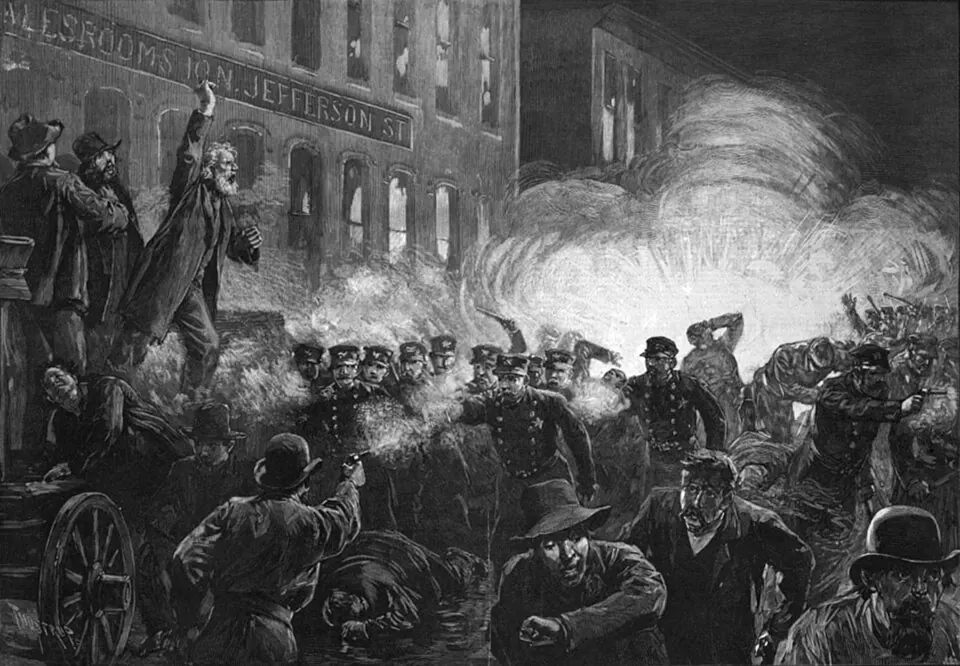
Between 300,000 and 500,000 workers strike in the United States for the eight-hour day, up to 40,000 in Chicago alone. On May 4, a bomb in Haymarket Square kills police officers and civilians, and four anarchists are hanged in 1887. In 1889, May 1 becomes Workers' Day in memory of Chicago.
The clash in Haymarket Square, engraving from Harper's Weekly (1886). Public domain
1890
Punched cards count the population
In the US census, Herman Hollerith's tabulating machines read data recorded as holes in cards. The 1880 census had taken about eight years to process; the 1890 census, about six. Hollerith's company would become IBM in 1924. Office work begins to be mechanized.
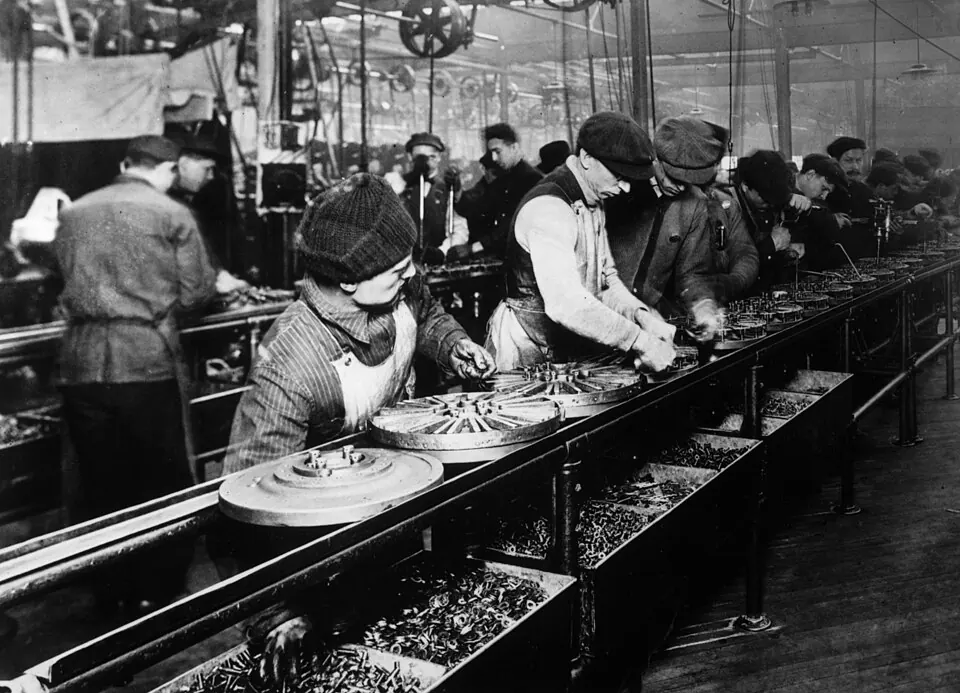
Ford installs moving assembly lines at Highland Park, Michigan. Assembling a Model T took 12 and a half hours; by early 1914, a finished car comes off the line every 93 minutes. Between 1908 and 1927, the car's price falls from $850 to as low as $260.
Ford announces $5 for an eight-hour day, up from $2.34 for nine hours before. The goal is to curb turnover, which had reached 380% a year: the repetitive work on the assembly line was so bad that nobody stayed.
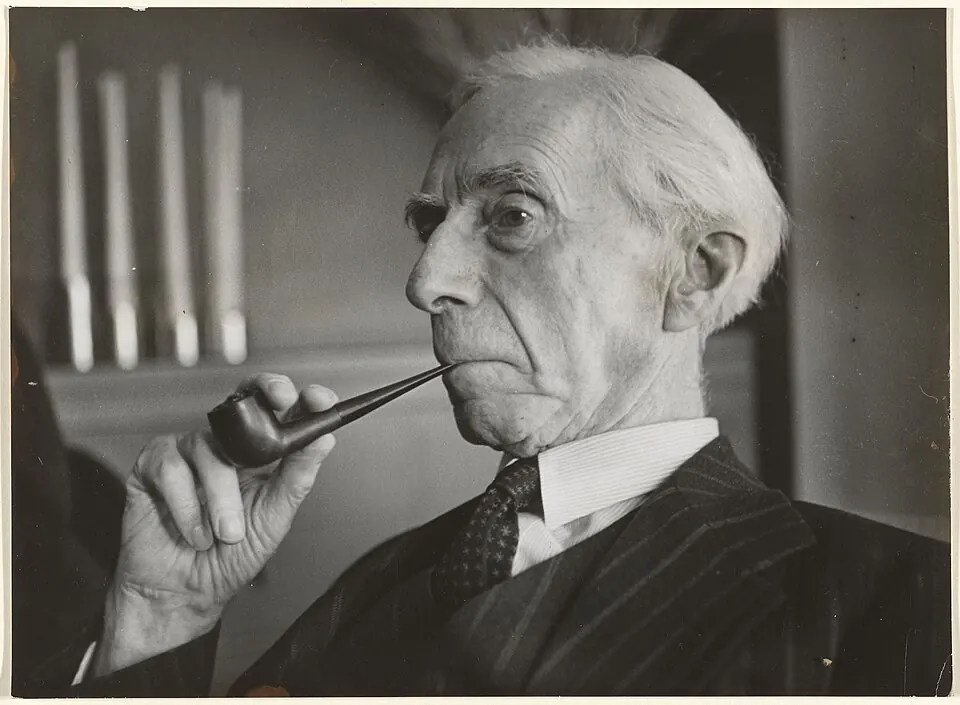
In the United Kingdom, Dennis and Mabel Milner propose a weekly, unconditional income for all citizens, equal to 20% of GDP per person. That same year, Bertrand Russell argues for a small income for everyone, whether they work or not. The Labour Party debates the idea and rejects it in 1921.
The newly created International Labour Organization adopts its first convention: a maximum of 8 hours a day and 48 a week in industry. A century after Owen's slogan, the eight-hour day becomes an international standard.
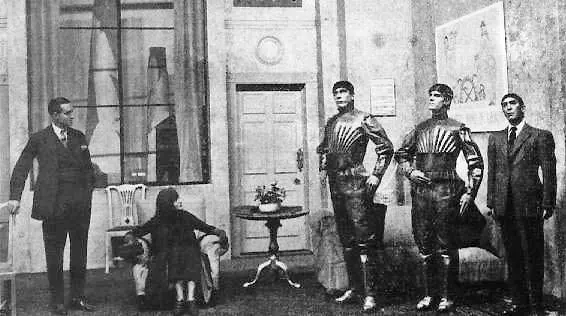
Karel Čapek's play "R.U.R." premieres in Prague. Its robots are artificial workers made in a factory to replace laborers. The word comes from the Czech "robota", forced labor, and was suggested by Josef, the author's brother. The robot was born as a synonym for worker.
Ford moves its factory workers to a five-day, 40-hour week, without cutting their six-day pay. Office staff get the same a few months later. The more productive machine frees up, for the first time on a large scale, a whole day of work.
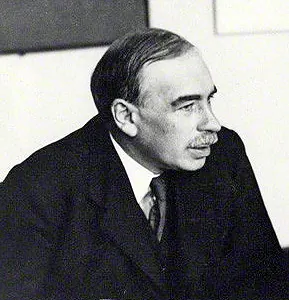
In the essay "Economic Possibilities for our Grandchildren", Keynes predicts that in a hundred years the standard of living will be "between four and eight times" higher. He warns of "technological unemployment" and suggests three-hour shifts or "a fifteen-hour week." His deadline falls in 2030.
In "In Praise of Idleness", Bertrand Russell writes that if the ordinary wage-earner worked four hours a day, "there would be enough for everybody and no unemployment." Using a pin factory that doubles its output, he shows how technology creates unemployment instead of leisure.
During the Great Depression, Franklin Roosevelt signs the Social Security Act: retirement pensions paid for by contributions on wages, unemployment insurance and aid to families with children headed by single mothers. The state begins to guarantee an income to those who cannot work.
In the paper "On Computable Numbers", Alan Turing describes an abstract machine that can imitate any other by reading its description on a tape. This "universal machine" is the theoretical basis of every computer.
Roosevelt signs the Fair Labor Standards Act: a federal minimum wage of 25 cents an hour, a workweek capped at 44 hours in the first year, and curbs on child labor.
In the short story "Runaround", Isaac Asimov sets out the Three Laws: a robot may not injure humans, must obey human orders and must protect itself, in that order. Almost all of his work shows how these laws fail.
William Beveridge presents the British government with a plan to defeat five giants: Want, Disease, Ignorance, Squalor and Idleness (unemployment). The text becomes the foundation of the British welfare state and its National Health Service.
Decree-Law 5,452 approves the CLT (Consolidação das Leis do Trabalho), which brings together Brazil's labor legislation and limits the normal workday to eight hours a day. It takes effect on November 10, 1943.
Computers and factory robots; guaranteed income becomes a serious proposal, in Brazil too.
1946
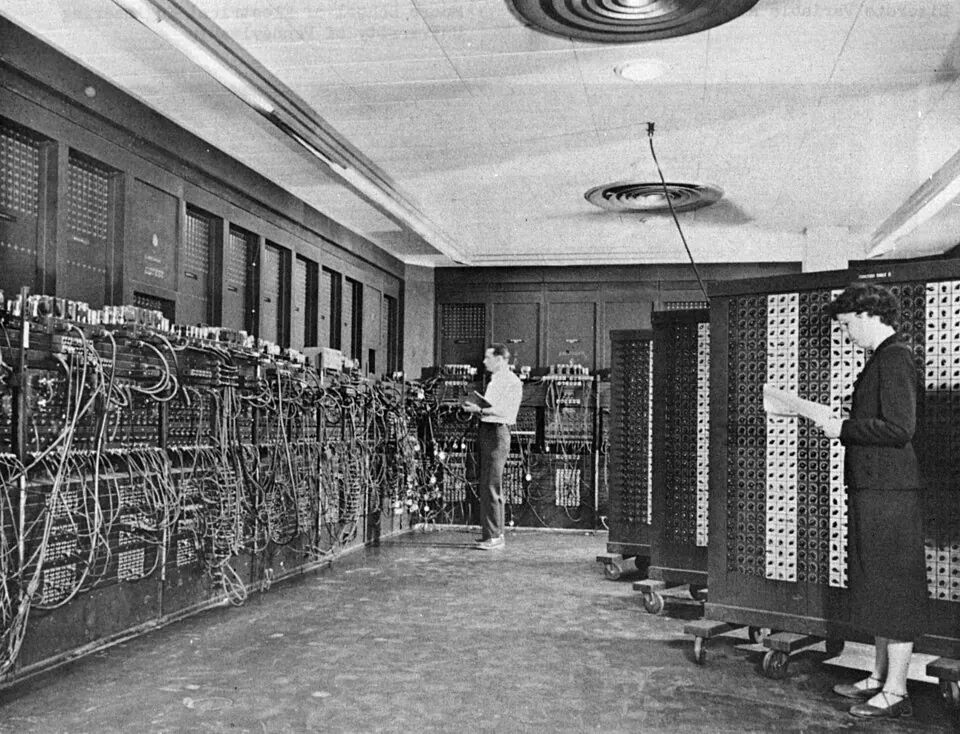
ENIAC, the first electronic computer
ENIAC weighs about 27 tons, uses 17,468 vacuum tubes and performs 5,000 additions per second. A ballistics calculation that took 12 hours by hand comes out in 30 seconds. Six women programmed it by rewiring cables, and the press of the time erased their work.
Glen Beck and Betty Snyder program ENIAC. Public domain
c.1947
The word "automation" enters the factory
Ford creates an automation department, and the word spreads. It comes to mean replacing steps of manual work with machines that are linked together and automatically controlled.
Wiener warns the union: the factory without workers is coming
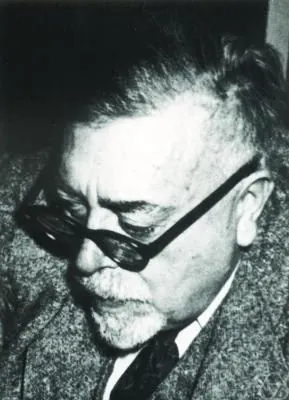
Norbert Wiener, the creator of cybernetics, writes to Walter Reuther, president of the United Auto Workers union. He warns that automatic machines will lead to "the factory without employees" and that the resulting unemployment "can only be disastrous" within 10 to 20 years.
In "The Human Use of Human Beings," Wiener writes that the automatic machine is "the precise economic equivalent of slave labor": any labor that competes with it will have to accept the conditions of slave labor. He predicted unemployment worse than that of the 1930s.
McCarthy, Minsky, Rochester and Shannon bring researchers together for about eight weeks at Dartmouth. The proposal coins the term and starts from a bet: "every aspect of learning or any other feature of intelligence can in principle be so precisely described that a machine can be made to simulate it."
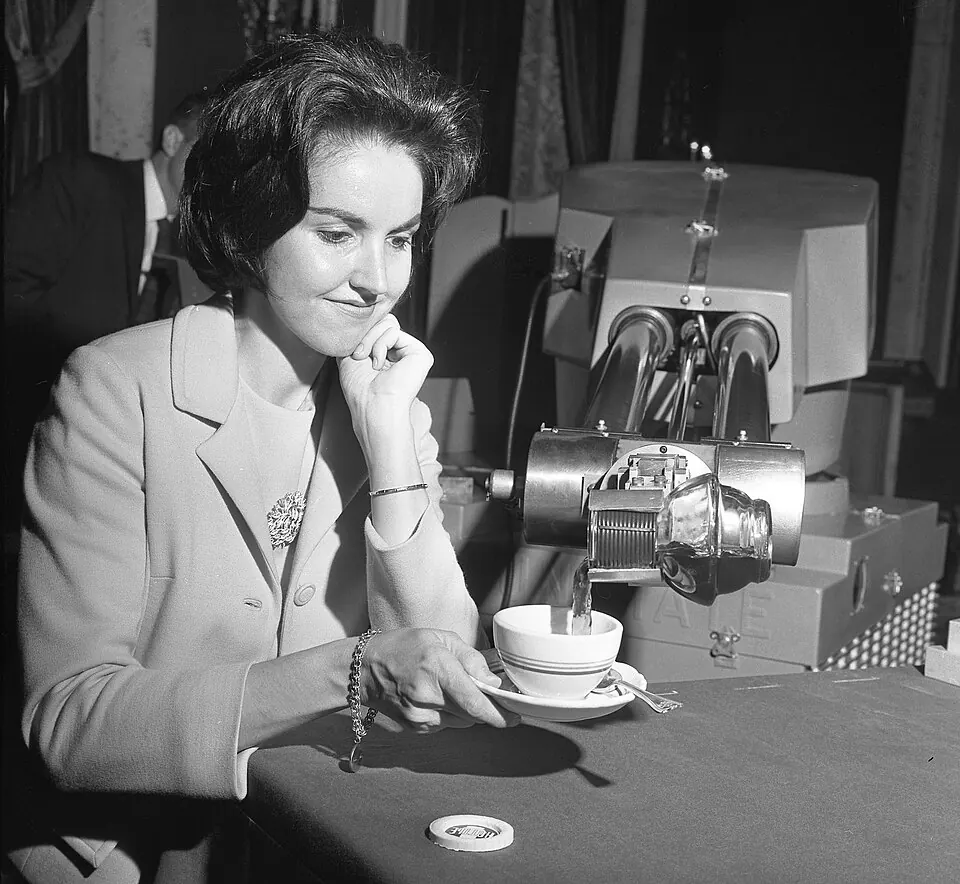
The Unimate arm, built by George Devol and Joseph Engelberger, starts working at a General Motors plant in New Jersey. It weighs about 1.8 tons, costs $25,000 and removes hot parts from die-casting machines, a dangerous task for workers.
A Unimate serves coffee at the Biltmore Hotel in 1967. CC BY 4.0
1962
Friedman proposes the negative income tax
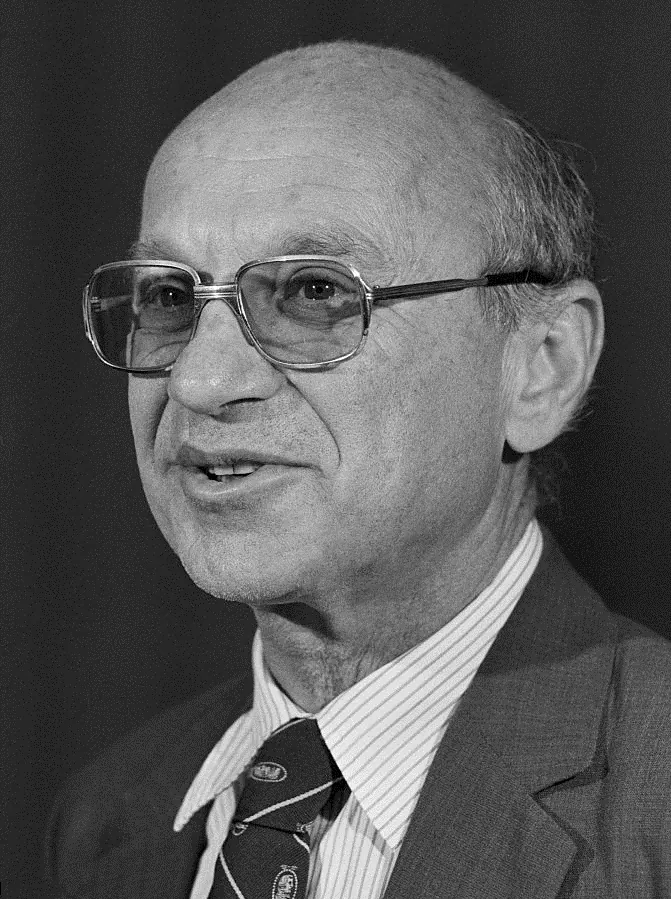
In "Capitalism and Freedom," Milton Friedman proposes that people earning below a certain threshold receive part of the difference from the government. The idea is to replace several social programs with a single one that is cheaper to administer. A free-market liberal and, later, the left arrive at the same idea by different paths.
Milton Friedman in 1976, the year of his Nobel. Public domain
1964
"The Triple Revolution" calls for income as a right
A committee of intellectuals sends President Lyndon Johnson a memo on "cybernation": computers and automation would bring almost unlimited productive capacity with less and less human labor. The text calls for an adequate income for every individual and every family "as a matter of right." It is signed by Linus Pauling, Gunnar Myrdal and Bayard Rustin, among others.
Joseph Weizenbaum, of MIT, publishes ELIZA, which imitates a psychotherapist by turning the user's sentences back into questions. His secretary, who had watched him program it for months, asks him to leave the room so she can talk to the machine in private.
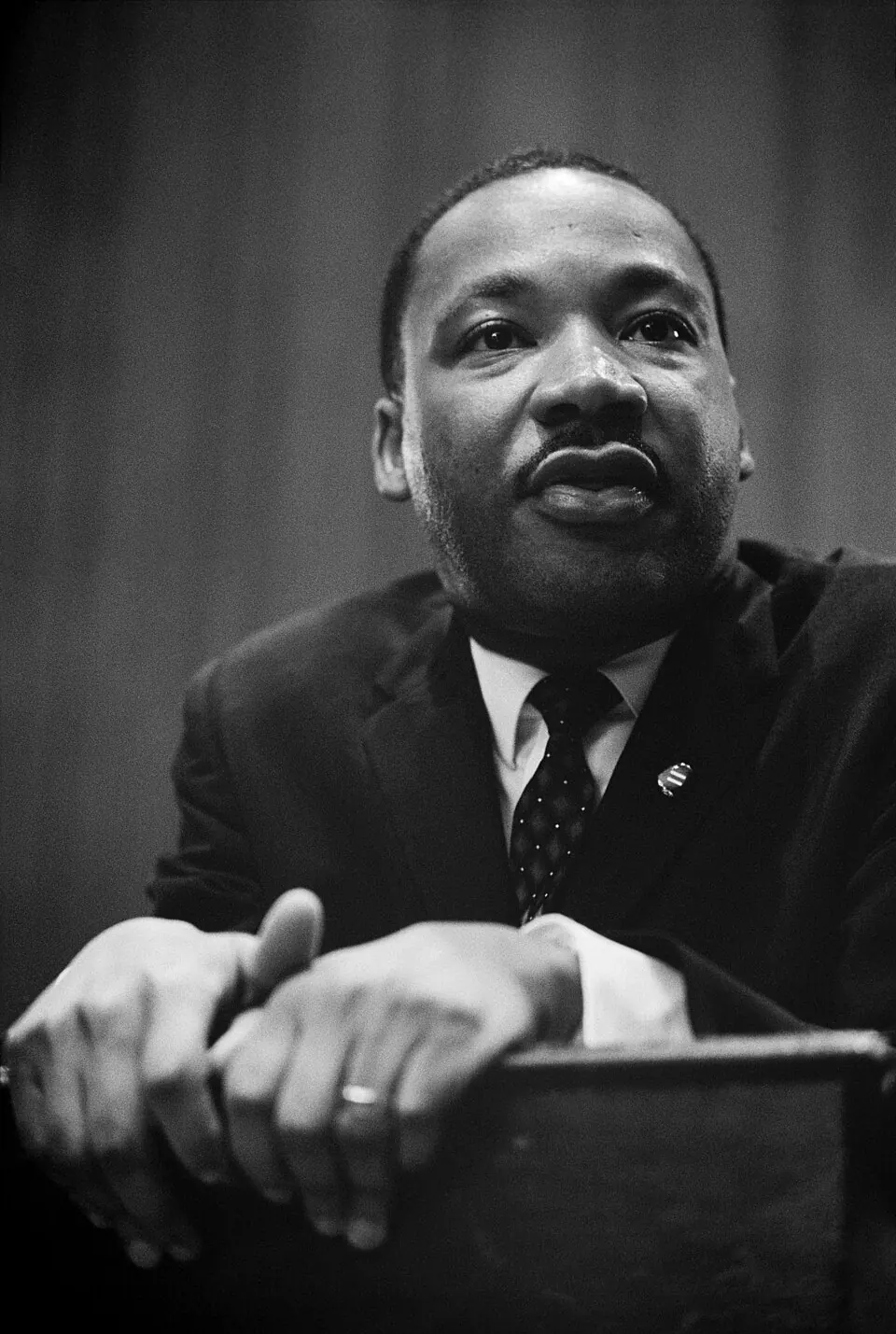
In the book "Where Do We Go from Here: Chaos or Community?" King writes that "the solution to poverty is to abolish it directly" through "the guaranteed income." He criticizes programs that attacked poverty indirectly.
John Kenneth Galbraith, James Tobin and Paul Samuelson, among others, ask the US Congress for a system of guaranteed income. About 1,200 economists sign, and the New York Times runs the letter on its front page.
The US tests the negative income tax in New Jersey
The first negative income tax experiment in the US begins, with 1,357 families followed for three years. In the four trials run through 1982, the reduction in work was modest: about two weeks a year for husbands and three for wives.
By a vote of 243 to 155, the House passes Richard Nixon's Family Assistance Plan: up to $1,600 a year for a family of four with no other income. The plan dies in the Senate. The US came within one step of a national minimum income.
That is what Life magazine calls Shakey, a robot from the SRI research institute that plans routes and rearranges objects on its own. In 1968, the project produced the A* algorithm, still used today in GPS and video games.
Shakey at the Computer History Museum. CC BY-SA 4.0
1974
Mincome: a minimum income for an entire town
Canada and Manitoba launch Mincome, which until 1979 guarantees a minimum income to every resident of Dauphin, a town of about 10,000 people. Hours worked fall only slightly: 1% among men. In 2011, economist Evelyn Forget finds 8.5% fewer hospitalizations.
Robert Williams, a Ford worker in Michigan, is killed when a one-ton robotic vehicle strikes him in an automated warehouse. He had climbed up to get parts by hand because the system showed the wrong inventory. His family is awarded $10 million in court, later raised to $15 million.
The Alaska Permanent Fund, created with oil revenue, pays $1,000 to every resident. The payment is annual, equal for everyone and unconditional, and it continues to this day. It is the closest thing there is to a permanent universal basic income.
Researchers and activists found the Basic Income European Network (BIEN) in Belgium. In 2004 it is renamed the Basic Income Earth Network and takes on a worldwide reach. Brazil's Eduardo Suplicy would become one of its honorary presidents.
In "Mind Children," Hans Moravec observes that it is easy to make a computer play checkers like an adult and almost impossible to give it the perception and mobility of a one-year-old. Decades later, the order held true: AI reached office work first, and robots are only now catching up with manual work.
Senator Eduardo Suplicy introduces the Minimum Income Guarantee Program, a negative income tax: anyone earning up to two minimum wages would receive 30% of the difference. The Senado passes it; the Câmara, Brazil's lower house, never votes on it.
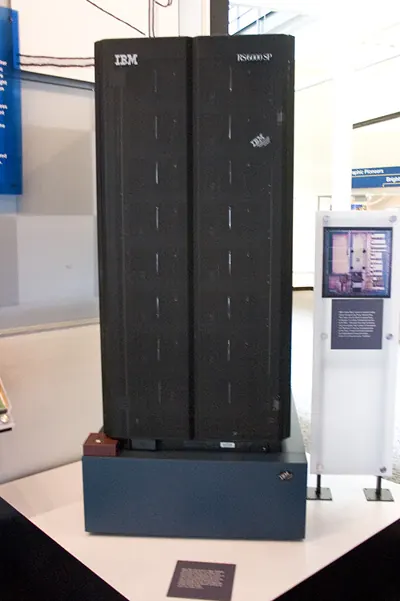
IBM's computer beats Garry Kasparov 3.5 to 2.5, the first defeat of a world champion by a machine under tournament conditions. With 32 processors, it evaluated 200 million positions per second.
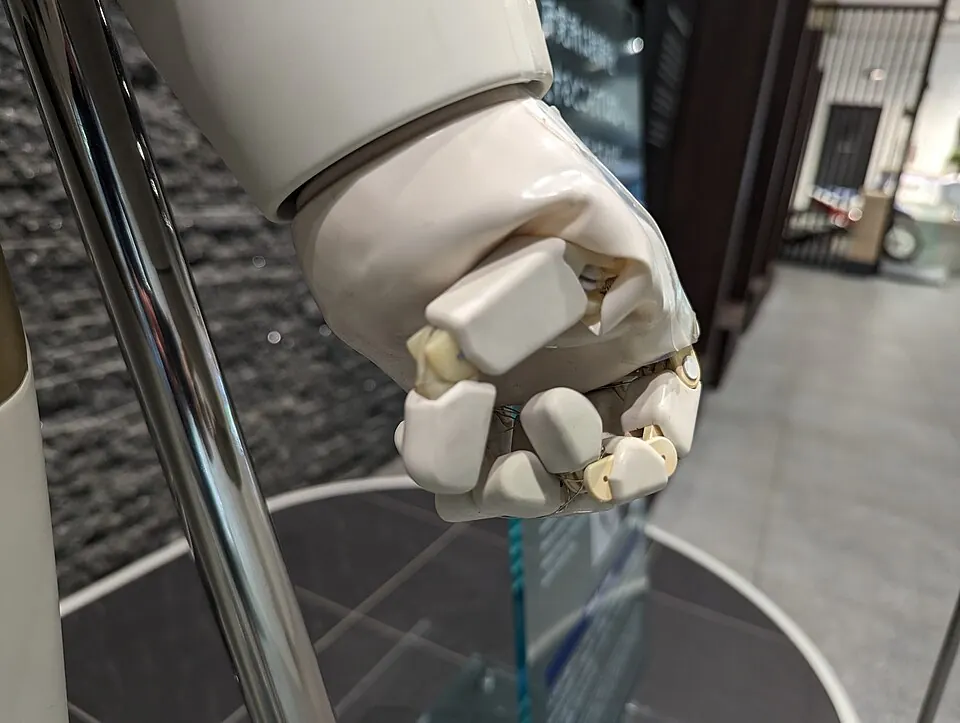
Honda unveils ASIMO, a robot that walks on two legs and climbs stairs. For two decades it was the image of the humanoid robot. The company ended the project in 2018 to focus on more practical robots.
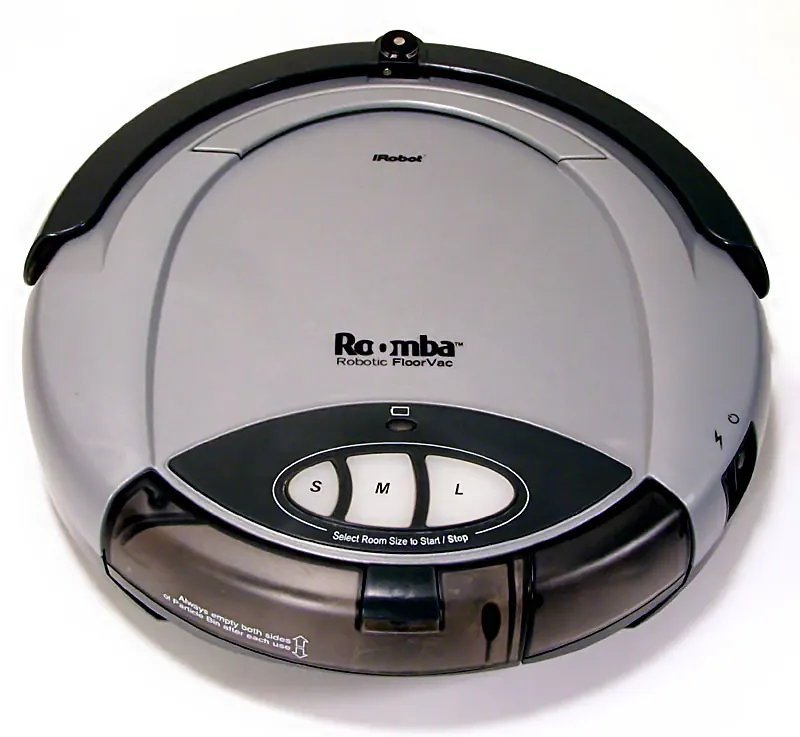
iRobot launches the Roomba, an autonomous vacuum cleaner billed as the first practical, affordable home robot. It passes 1 million units in 2004 and 40 million home robots sold in 2021. Housework gets its first mass-market robot.
Provisional Measure 132, a presidential decree, creates Bolsa Família, which merges federal cash transfer programs and sets conditions such as school attendance. It serves 3.6 million families in December 2003 and 13.3 million in 2011.
Lula signs Lei 10.835, by Senator Eduardo Suplicy: a basic income, equal for all Brazilians and for foreigners resident for five years, with no conditions. Brazil is cited as the first country to pass such a law, but implementation was left to the government's discretion, in stages, and was never completed.
Eduardo Suplicy, author of the law, in 2014. Photo: Jefferson Rudy/Agência Senado. CC BY 2.0
2008
Namibia tests basic income in Otjivero
January 2008
For two years, every resident under 60 in the village of Otjivero-Omitara, about a thousand people, receives 100 Namibian dollars a month. According to the organizers, child malnutrition falls from 42% to 10%.
The NGO ReCivitas begins paying R$30 a month, with no conditions, to residents of Quatinga Velho, a rural area of Mogi das Cruzes (São Paulo state), using private donations. There were 27 people at the start and 83 in 2011. The payments last until 2014.
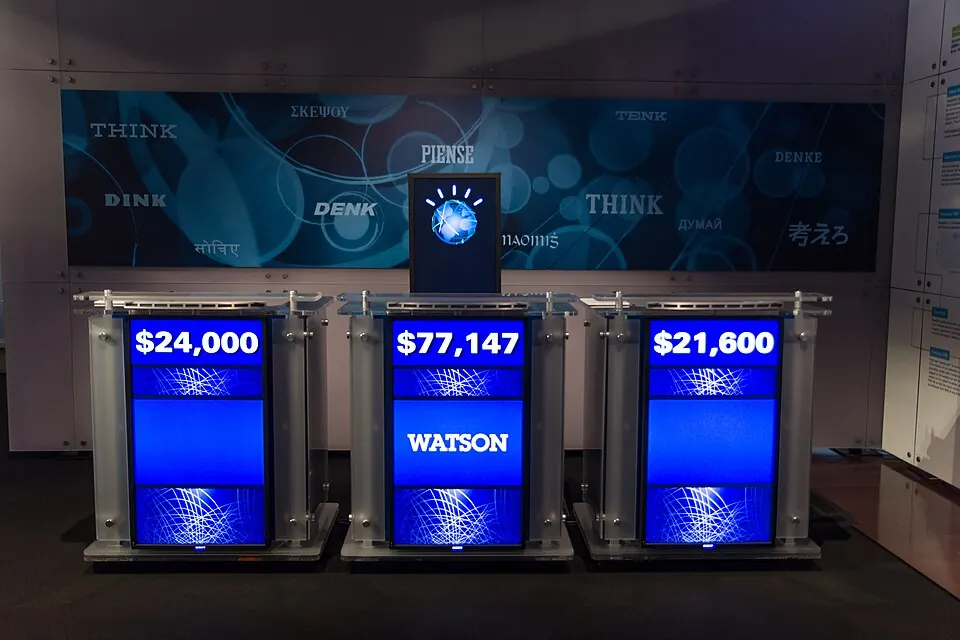
IBM's Watson racks up $77,147 against $24,000 for Ken Jennings and $21,600 for Brad Rutter, answering questions full of puns. In the final round, Jennings writes: "I for one welcome our new computer overlords."
AI learns intellectual work, robots get cheap and start understanding spoken orders.
2012
Amazon buys Kiva and its robots
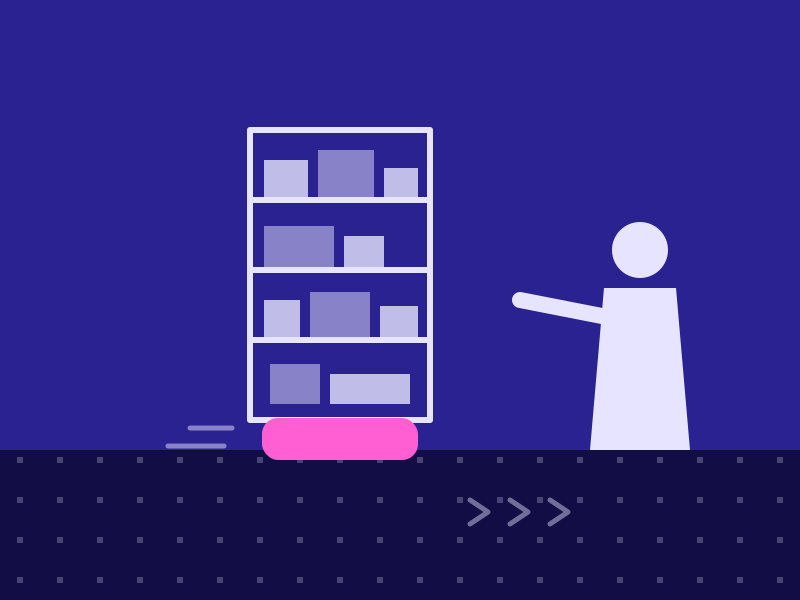
For about $775 million, Amazon buys Kiva Systems, whose robots bring shelves to warehouse workers instead of people walking to them. Thirteen years later, the company would have 1 million robots.
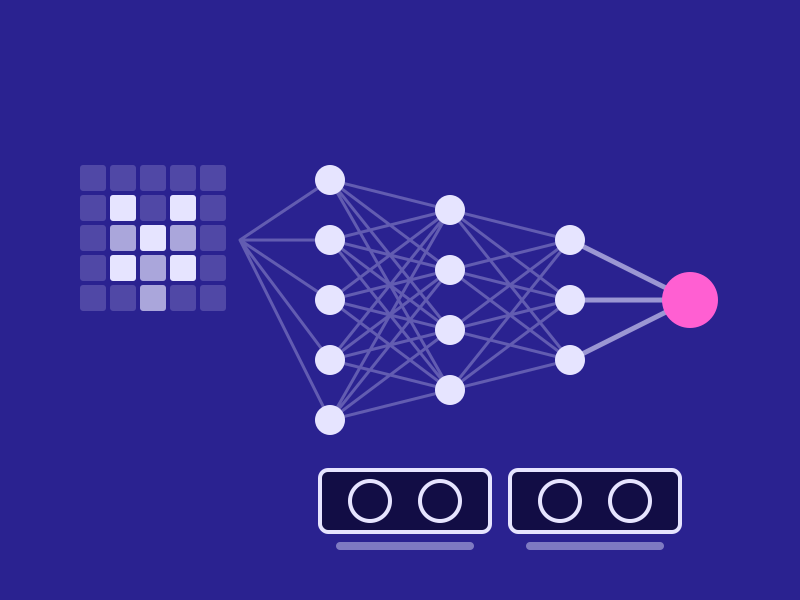
The neural network built by Alex Krizhevsky, Ilya Sutskever and Geoffrey Hinton wins the ImageNet challenge with a 15.3% error rate, against 26.2% for the runner-up. It was trained on two gaming graphics cards. Almost everything that came after starts here.
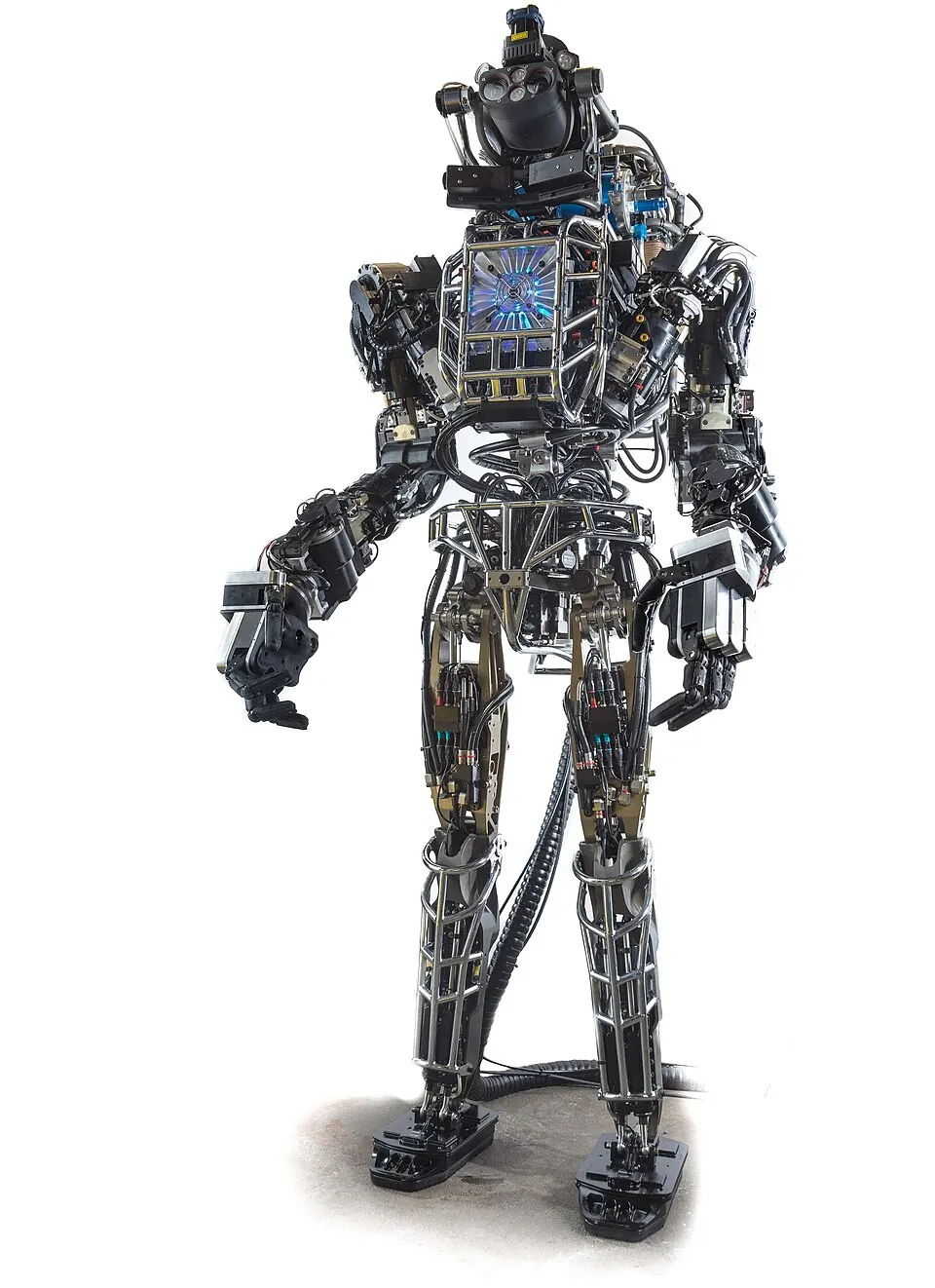
DARPA and Boston Dynamics unveil Atlas for a rescue robot competition created after Fukushima, where wheeled robots could not get past the rubble. The program manager compares the robot to a one-year-old child.
Carl Benedikt Frey and Michael Osborne, of the University of Oxford, estimate the probability of automation for 702 occupations and conclude that about 47% of US employment is at high risk. The study becomes a reference point in the debate about the end of work.
Swiss activists hand in more than 100,000 signatures to put basic income to a referendum and dump about 8 million 5-cent coins in front of Parliament, one for each inhabitant. They propose 2,500 francs a month for every adult.
The action of October 4, 2013, in Bern. Public domain
2016
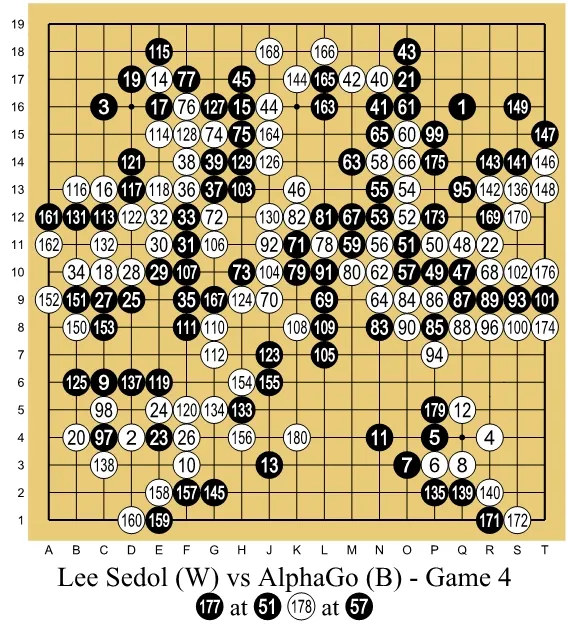
AlphaGo beats Lee Sedol
DeepMind's AlphaGo beats the South Korean champion 4 to 1 at Go, a game once considered too difficult for machines. In 2019, Lee retires: "Even if I become the number one, there is an entity that cannot be defeated."
In a national referendum, 76.9% of voters and all 26 cantons reject an unconditional basic income. It was the first time an entire country had voted on the idea.
For two years, 2,000 unemployed people chosen by lottery receive 560 euros a month, with no conditions. The effect on employment is small, about six more days of work in the second year, but participants report greater life satisfaction and less stress.
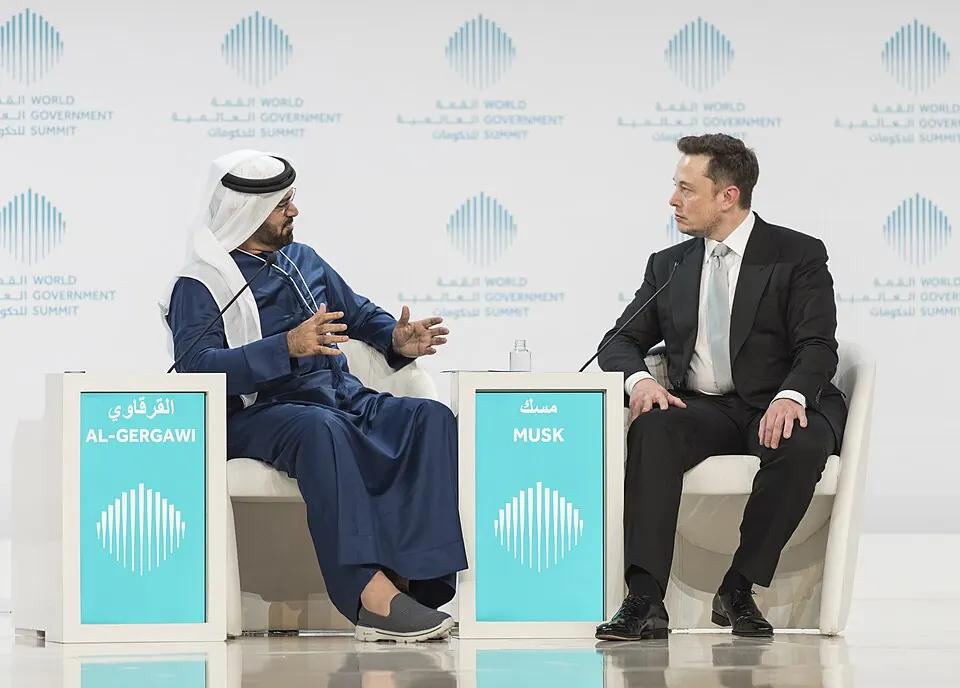
At the World Government Summit in Dubai, Elon Musk repeats what he had told CNBC in 2016: "There will be fewer and fewer jobs that a robot cannot do better" and "some kind of universal basic income will be necessary."
Elon Musk at the World Government Summit in Dubai on February 13, 2017. CC BY-SA 4.0
2017
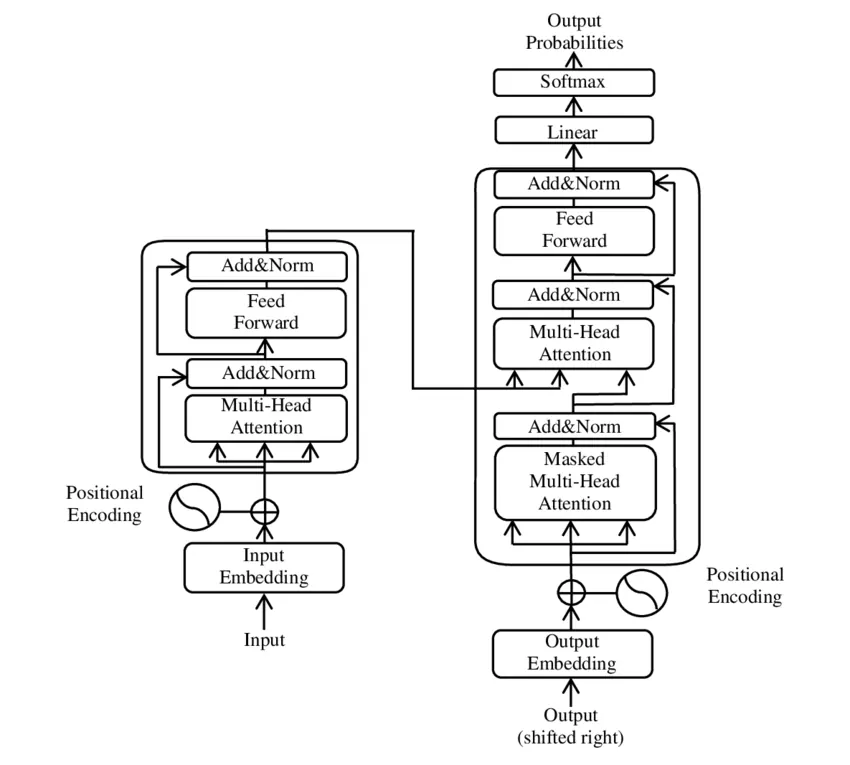
Attention Is All You Need
Eight researchers, almost all from Google, present the Transformer, an architecture that looks at all the words in a text at the same time and calculates which ones matter most. It becomes the foundation of large language models. It is the T in GPT.
Diagram of the Transformer architecture. CC BY-SA 3.0
2017
Kenya: basic income for 12 years
November 2017
The NGO GiveDirectly begins one of the world's largest basic income trials: in 44 villages, every adult receives about $0.75 a day, paid every month, for 12 years. The study covers 295 villages and more than 14,000 households.
According to the International Federation of Robotics, about 2.1 million industrial robots are in operation at the end of 2017, up 15% in one year. China alone has about 473,000.
The first Amazon Go opens to the public in Seattle. With "Just Walk Out" technology, customers pick up products and leave without going through a checkout or self-checkout.
Waymo, which began as Google's self-driving car project, launches Waymo One in the Phoenix area. In 2020, it becomes the first company to offer rides to the public without a safety driver.
The city of Stockton, California, pays $500 a month, with no conditions, to 125 residents for two years. After one year, full-time employment among them rises from 28% to 40%, more than double the increase in the control group.
Maricá expands its basic income in its own currency
A municipal law raises the Citizen's Basic Income of Maricá (Rio de Janeiro state) to 130 mumbucas per person. The mumbuca is a social currency worth R$1 that circulates only in local shops. The program began in 2013 as Bolsa Mumbuca.
Andrew Yang takes basic income to the presidential race
2019
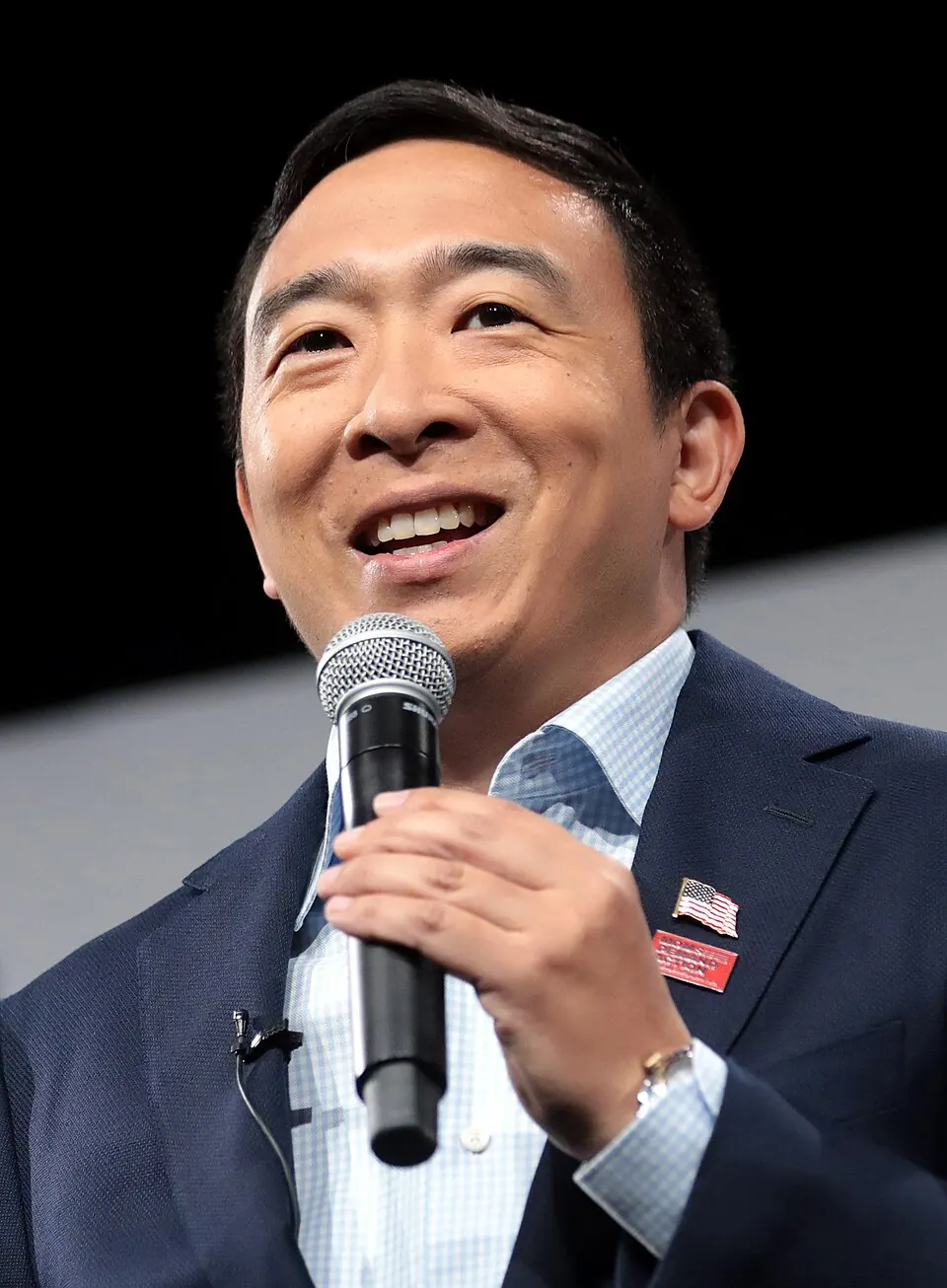
Entrepreneur Andrew Yang runs in the Democratic primaries promising the "Freedom Dividend": $1,000 a month for every American adult, because of automation. He takes part in every 2019 debate and drops out in February 2020.
Andrew Yang campaigning in Des Moines, August 2019. CC BY-SA 3.0
2020
Auxílio Emergencial: R$600 for 68 million
During the pandemic, Lei 13.982 creates the Auxílio Emergencial (emergency aid): R$600 a month for informal and low-income workers and R$1,200 for mothers who head their households. There are 68.2 million beneficiaries, about a third of Brazil's population.
OpenAI releases GPT-3, a language model with 175 billion parameters that can draft texts, answer questions and write code from just a few examples. In June, it opens access to businesses through an API.
The International Federation of Robotics counts about 3 million industrial robots in operation. The global average reaches 126 robots per 10,000 manufacturing workers, almost double the 2015 figure.
In the essay "Moore's Law for Everything," Altman predicts that "software that can think and learn will do more and more of the work that people now do." He proposes a fund paid for by a 2.5% tax on large companies and land, which would provide about $13,500 per adult per year within ten years.
Ruling on Mandado de Injunção 7300, a constitutional writ, the STF, Brazil's Supreme Court, recognizes that the government failed to regulate Lei 10.835 for 17 years and orders the citizen's basic income to be implemented, starting with people in poverty and extreme poverty.
The robot that understands a plain-language request
Google Research and Everyday Robots publish PaLM-SayCan: the language model turns requests like "I just worked out, bring me a snack and a drink" into sequences of actions that a robot carries out in a real kitchen. The era of programming robots by talking begins.
OpenAI launches ChatGPT. In about two months, it reaches 100 million monthly users; TikTok took nine months, and Instagram two and a half years. AI leaves the lab and enters everyone's work.
The government relaunches Bolsa Família, Brazil's cash-transfer program, with a floor of R$600 per family and an extra R$150 per child up to age six. It is a conditional transfer, not universal income, but it is the largest income safety net in the country.
OpenAI launches GPT-4 and reports that it scored 298 out of 400 on the US bar exam, which would place it in the top 10% of test takers. A later academic reassessment estimated a lower performance, but still a passing one.
Goldman Sachs economists estimate that generative AI could expose the equivalent of 300 million full-time jobs worldwide to automation. About two-thirds of jobs would have some exposure; administrative and legal work would be the most affected.
Google DeepMind introduces RT-2, a model that uses knowledge from the internet to turn text instructions into robot motor commands. On never-before-seen tasks, the success rate rises from 32% to 62%.
In a conversation with British Prime Minister Rishi Sunak, Elon Musk calls AI "the most disruptive force in history" and says "there will come a point where no job is needed"; people would work only for personal satisfaction.
IMF Managing Director Kristalina Georgieva says almost 40% of global employment is exposed to AI, about 60% in advanced economies. She calls for social safety nets and retraining.
A Goldman Sachs report estimates that the cost of making a humanoid robot fell about 40%: from between $50,000 and $250,000 per unit to between $30,000 and $150,000, thanks to cheaper components. Analysts had expected 15% to 20% a year.
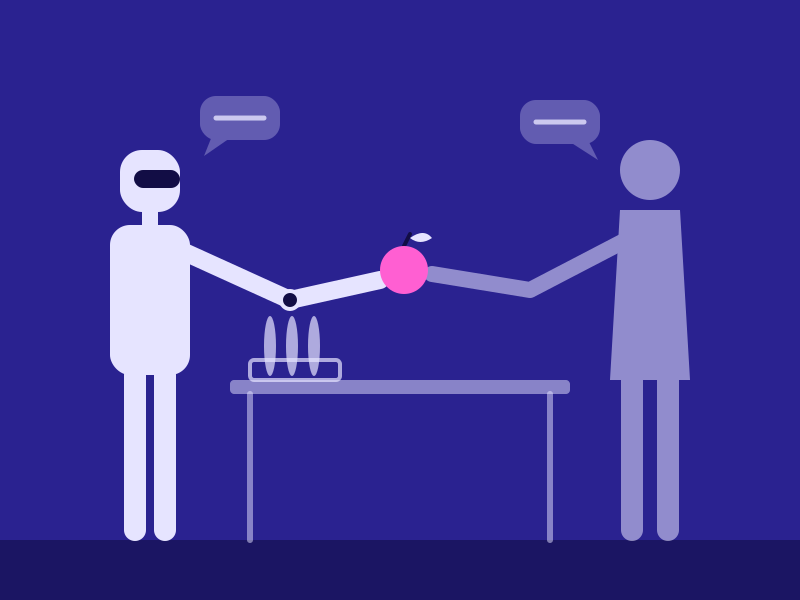
Figure AI shows its humanoid, running an OpenAI model, talking with a person while putting away dishes. When it hears that the person is hungry, it hands over an apple and explains that it was the only edible item on the table. Giving orders to a robot becomes a conversation.
Boston Dynamics retires the hydraulic Atlas and unveils a fully electric version, stronger and with a greater range of motion, for testing in Hyundai factories.
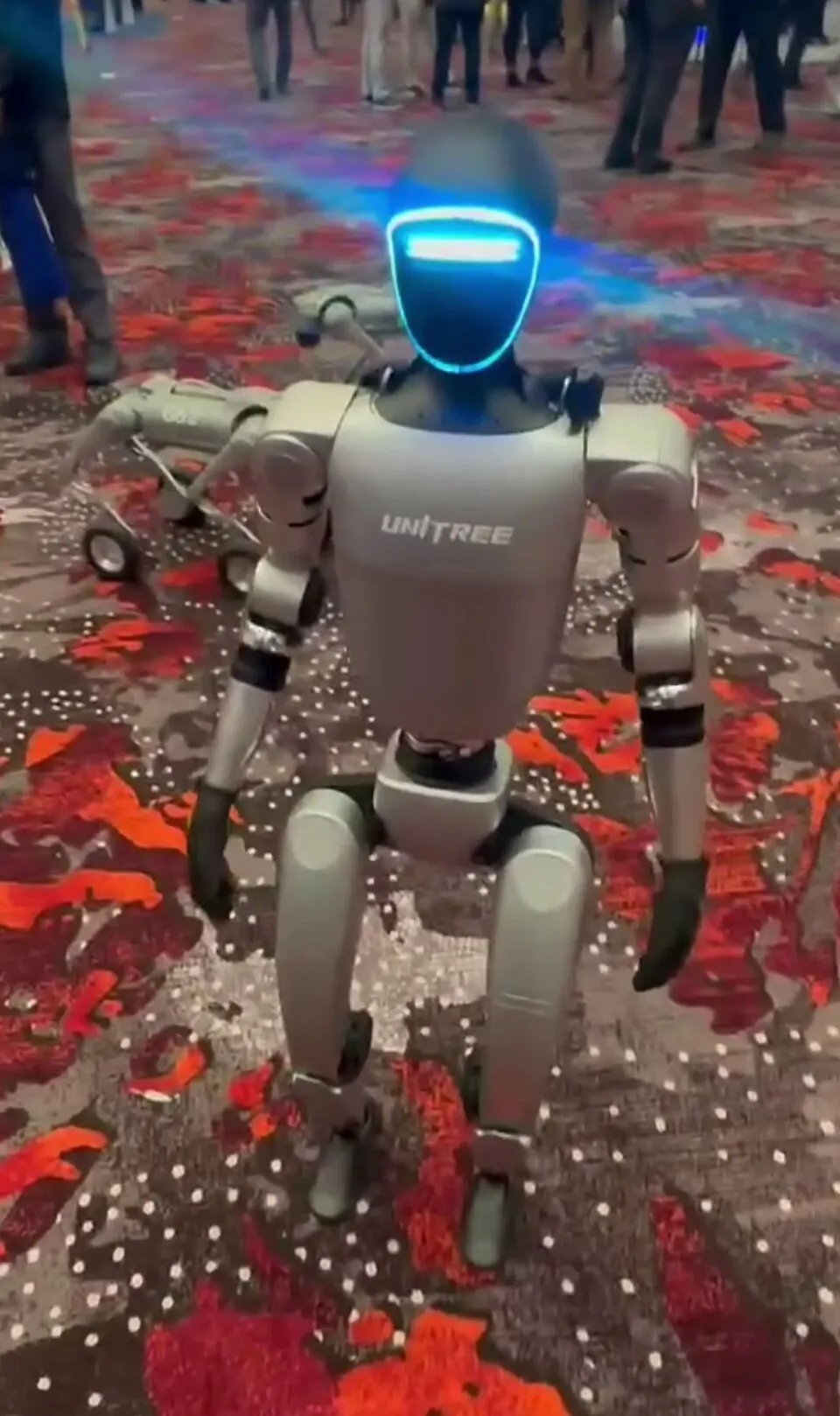
China's Unitree unveils the G1, a 1.27 m humanoid with a base version at $16,000. The company's larger model cost $90,000. Humanoid robots start to cost as much as an economy car.
Hinton recommends basic income to the British government
May 2024
Geoffrey Hinton tells the BBC he is "very worried about AI taking lots of mundane jobs" and says he advised the British government that "universal basic income was a good idea". In his view, productivity gains would go to the rich, not to the people who lose their jobs.
At VivaTech in Paris, Elon Musk says that "in a benign scenario, probably none of us will have a job" and that working will be optional, like a hobby. He predicts "universal high income, not universal basic income".
Logistics company GXO signs a multi-year "robots-as-a-service" contract with Agility Robotics to use the Digit humanoid in a warehouse near Atlanta, carrying boxes to conveyor belts. The robot is now rented out as labor.
OpenResearch, funded by Sam Altman, releases three years of results: 1,000 people received $1,000 a month. They worked about 1.3 fewer hours per week and spent more on food, housing and transportation.
BMW announces that the Figure 02 humanoid completed a weeks-long test at its Spartanburg plant in the US, placing sheet metal parts into assembly fixtures on its own.
The Nobel Prize in Physics goes to John Hopfield and Geoffrey Hinton for artificial neural networks. The next day, half of the Nobel Prize in Chemistry goes to Demis Hassabis and John Jumper, of Google DeepMind, for protein structure prediction.
Geoffrey Hinton, 2024 Nobel Prize in Physics. CC BY-SA 4.0
2024
Optimus for the price of a car
At the "We, Robot" event, Elon Musk says the Optimus humanoid should cost, at large scale, between $20,000 and $30,000, less than a car. Analysts estimate a much higher initial cost.
Startup Physical Intelligence introduces π0, a model that follows text instructions and generates motor commands up to 50 times per second. In the demos, robots take clothes out of a dryer and fold them, clean tables and assemble boxes.
On Jimmy Fallon's show, Bill Gates says that within ten years AI will make good medical advice and good tutoring cheap and commonplace. Asked whether humans will still be needed, he answers: "not for most things".
Figure AI introduces Helix, which controls a humanoid's torso and fingers from natural language commands. When it hears "pick up the desert item", the robot picks a toy cactus. Two robots work together to put away groceries they had never seen.
Google DeepMind launches Gemini Robotics, which takes orders in everyday language, in several languages, turns them into physical actions and replans when something changes.
At its GTC conference, Nvidia launches Isaac GR00T N1, the first open foundation model for humanoid robots, trained on videos of people, real robot movements and synthetic data.
The METR institute measures how long the tasks that AI agents can complete take: that length has been doubling roughly every seven months for six years. If the trend holds, projects that take a month of human work would be automatable by the end of the decade.
Daniel Kokotajlo's AI Futures Project publishes a month-by-month scenario: a "superhuman coder" in early 2027, autonomous AI researchers in mid-2027 and superintelligence soon after. The authors treat it as a guess, with great uncertainty.
In Beijing, 21 humanoid robots start alongside 12,000 runners. The winner, Tiangong Ultra, covers the 21 km in 2:40:42, swapping its battery three times. Only six robots finish; the best human takes about 1:02.
Anthropic CEO Dario Amodei warns that AI could eliminate half of entry-level white-collar jobs within five years and push US unemployment to 10% or 20%. Technology, finance, law and consulting would be the most exposed fields.
In the essay "The Gentle Singularity", Sam Altman writes that there will be "very hard parts like whole classes of jobs going away". He predicts systems capable of novel discoveries in 2026 and robots doing tasks in the real world in 2027.
Amazon announces its 1 millionth robot, across a network of more than 300 facilities, and launches an AI that coordinates the entire fleet. Thirteen years after buying Kiva.
Maricá's Renda Básica de Cidadania (Citizen's Basic Income), in Rio de Janeiro state, pays 230 mumbucas, the city's local currency, per month to each recipient, covering more than 90,000 people, almost half the city. It is the largest municipal basic income experiment in Brazil.
The study "Canaries in the Coal Mine?", based on payroll data, finds that workers aged 22 to 25 in the occupations most exposed to AI saw a 13% relative decline in employment since generative AI became widespread.
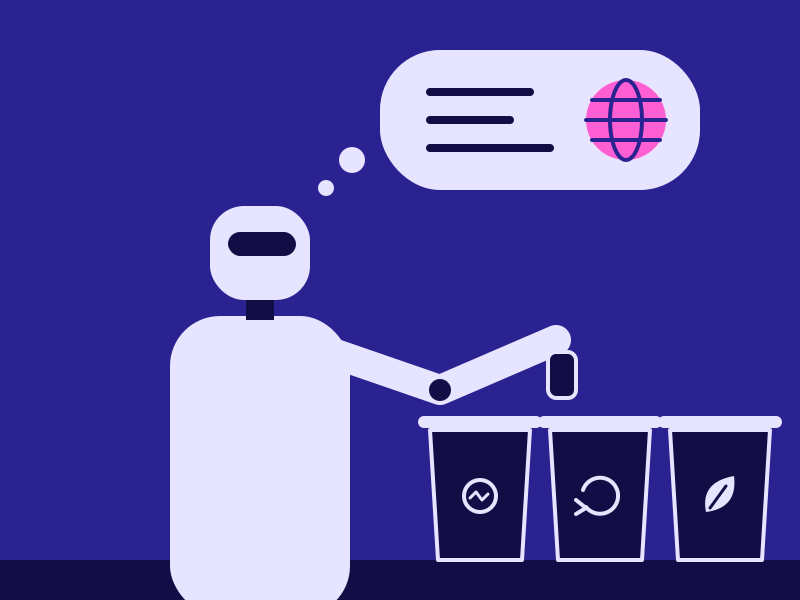
Google DeepMind launches Gemini Robotics 1.5, which reasons in natural language before acting and can search the internet. In the demo, the robot looks up the local recycling rules and sorts objects into trash, recycling and compost.
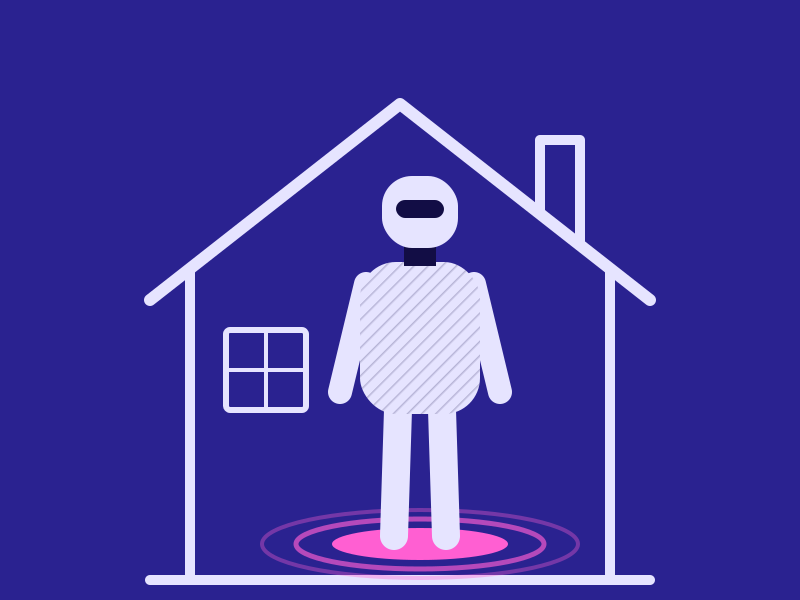
Figure AI launches Figure 03, a humanoid designed for home use, with a washable covering, wireless charging through its feet and fingertip sensors that can feel 3 grams. The factory can produce up to 12,000 a year.
The New York Times reveals internal documents: Amazon expects robots to take more than 600,000 jobs it would otherwise have to fill in the US by 2033, automating 75% of its operations. The company says the documents are incomplete.
1X opens preorders for NEO, a humanoid for household chores, at $20,000 or a $499 monthly subscription. On unfamiliar tasks, a company expert can guide the robot remotely.
Amazon confirms it is cutting about 14,000 corporate roles. Months earlier, CEO Andy Jassy had written that AI would mean the company would "need fewer people doing some of the jobs that are being done today". Later, he attributed the cuts to "culture".
Tesla shareholders approve a package for Elon Musk that could be worth about $1 trillion in stock. Among the targets: delivering 1 million Optimus robots.
At the US-Saudi Investment Forum in Washington, Musk predicts, alongside Nvidia's Jensen Huang, that work will be optional in 10 or 20 years. The same day, Figure retires its BMW robots, which, according to the company, helped produce more than 30,000 cars.
Replying to investor Ray Dalio on X, Musk writes that "there will be no poverty in the future and so no need to save money. There will be universal high income".
Consulting firm Challenger, Gray & Christmas counts 1.21 million announced job cuts in the US in 2025, the highest total since 2020. Artificial intelligence is the stated reason for 54,836 of them.
According to research firm Omdia, about 13,000 humanoid robots were delivered worldwide in 2025. Chinese companies AgiBot (5,168), Unitree (4,200) and UBTech (1,000) lead.
In its first payment of 2026, Bolsa Família, Brazil's cash-transfer program, reaches 18.77 million families, about 49 million people, with an average benefit of R$697.77.
On his first visit to the World Economic Forum, Elon Musk predicts there will be more robots than people and that "everyone on Earth is going to want one". He calls robots and AI "the path to abundance for all".
Amazon announces another 16,000 corporate job cuts, bringing the total to about 30,000 since October 2025. The company talks about reducing layers and bureaucracy.
Jason Stockwood, the UK's investment minister, tells the Financial Times that the country will have to think about a "soft landing for the industries that will go away" and mentions "some sort of universal basic income".
Jack Dorsey's Block announces it is cutting about 4,000 employees, almost half its workforce, and justifies the decision by the use of the AI tools the company itself builds.
At Beijing's second humanoid half marathon, with more than 100 teams, the winning robot runs the 21 km on its own in 50:26, about 7 minutes under the human world record. A year earlier, the winner had taken 2:40.
Tesla delays the unveiling of Optimus V3 and says production in Fremont will start "very slow" in the middle of the year. In January, Musk had admitted that no Optimus was doing "useful work" in the factories. The target of 10,000 robots in 2025 was not met.
In an SEC filing, Oracle reveals it cut about 21,000 jobs, almost 13% of its workforce, in 12 months, and states that "the adoption and deployment of AI technologies" led to the reductions.
Musk writes on X: "AI and robots will be able to do everything, resulting in universal high income. Work will be optional". In April, he had already defended federal government checks as the best way to deal with unemployment caused by AI.
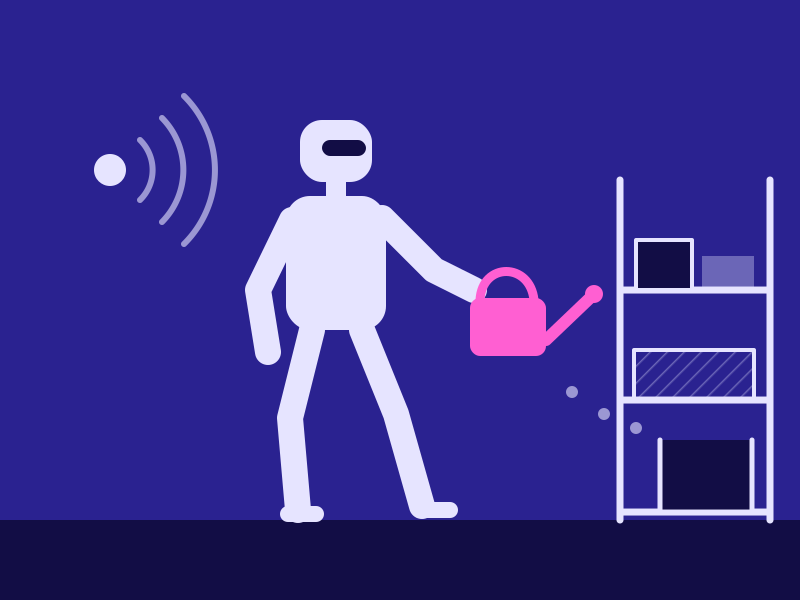
Google DeepMind launches Gemini Robotics 2, which turns images and spoken instructions into movements of the legs, torso, arms and fingers. When it hears "put the watering can in the green box on the bottom shelf", the humanoid walks over, picks up the object and puts it away.
The revised version of the study by Brynjolfsson, Chandar and Chen, with data through June 2026, shows an even larger drop in employment for 22- to 25-year-olds in AI-exposed occupations than the 13% measured in 2025.
The Chinese humanoid maker ends its first day on the Shanghai stock exchange valued at nearly $50 billion. In 2025, it had revenue of 1.7 billion yuan, four times the previous year, and sold more than 5,000 humanoids.
Unitree's official store lists the R1 AIR at $4,900 and the base G1 at $13,500, below the $16,000 of 2024. In two years, the entry price of a humanoid has fallen about 70%.
The World Robotics 2026 report says the global stock of industrial robots reached a record 5 million in 2025. Factories installed more than 600,000 new robots during the year.
US employers cited artificial intelligence in 120,136 job cuts from January to September 2026, about 21% of the total. It is the top reason of the year and more than double the total for all of 2025.
From here down, nothing has happened yet. Each forecast says who made it and where.
2027
AI does the work of programmers
by January 2027
At Davos, Dario Amodei said AI could do most, maybe all, of the work of software engineers within 6 to 12 months. The maximum deadline runs out here.
Forecast: Dario Amodei (Anthropic), January 2026. Source: Storyboard18
Illustration: lastday.at. This photo has not been taken yet.
2027
Nobel-level AI
late 2026 or early 2027
Anthropic told the White House it expects AI systems with intellectual capabilities matching or exceeding those of Nobel Prize winners across most disciplines, able to work autonomously on tasks lasting hours or days.
Forecast: Anthropic, March 2025. Source: Anthropic
Illustration: lastday.at. This photo has not been taken yet.
2027
The superhuman coder
March 2027
In the AI 2027 scenario, an AI appears that codes better than any person, running as 200,000 copies in parallel. The authors later said the real pace is somewhat slower.
Forecast: Daniel Kokotajlo and team (AI Futures Project), 2025. Source: AI 2027
Illustration: lastday.at. This photo has not been taken yet.
2027
The end of office work
AI agents start doing computer work from start to finish: emails, spreadsheets, reports, customer service, accounting, analysis. Hiring a person for a task done only in front of a screen stops making economic sense. It is the first major category of work to end.
Illustration: lastday.at. This photo has not been taken yet.
2027
AGI by 2027 is "strikingly plausible"
In the essay "Situational Awareness", former OpenAI researcher Leopold Aschenbrenner extrapolates the growth of compute and algorithmic efficiency and concludes that artificial general intelligence by 2027 is "strikingly plausible".
Illustration: lastday.at. This photo has not been taken yet.
2027
Robots do tasks in the real world
In the essay "The Gentle Singularity", Sam Altman wrote that 2027 may see the arrival of robots that can do tasks in the real world, after systems that make new discoveries in 2026.
Illustration: lastday.at. This photo has not been taken yet.
2027
South Korea tests basic income
South Korea's Ministry of Health and Welfare set up a task force to institutionalize basic income, with a pilot planned for 2027. The government justifies the measure by the structural unemployment AI is expected to cause among young people.
Forecast: Government of South Korea, 2026. Source: Asia Economy
Illustration: lastday.at. This photo has not been taken yet.
2027
10,000 industrial humanoids a year from a single factory
China's UBTech announced capacity for 5,000 industrial humanoids in 2026 and 10,000 in 2027, with the Walker S2 already in mass production.
Forecast: UBTech, November 2025. Source: Korea Herald
Illustration: lastday.at. This photo has not been taken yet.
2027
100,000 NEO home robots
After selling out its first-year batch in five days, 1X aims to produce 100,000 units of the NEO home humanoid in 2027.
Illustration: lastday.at. This photo has not been taken yet.
2027
The humanoid market tops $2 billion
The consultancy TrendForce forecasts that the global humanoid robot market will exceed $2 billion in 2027, growing an average of 154% a year since 2024.
Forecast: TrendForce, November 2024. Source: TrendForce
Illustration: lastday.at. This photo has not been taken yet.
2027
Every hiring process tests for AI
Gartner predicts that 75% of hiring processes will include AI proficiency certifications and tests. Knowing how to work with the machine becomes a requirement for what little work remains.
Illustration: lastday.at. This photo has not been taken yet.
2027
Half give up on cutting all service agents
Going the other way, Gartner predicts that half of the companies that planned to sharply reduce human customer service because of AI will abandon those plans, because complex conversations still require people.
Forecast: Gartner, September 2025. Source: CX Network
Illustration: lastday.at. This photo has not been taken yet.
2027
Office tasks fully automated
by August 2027
Mustafa Suleyman, CEO of Microsoft AI, told the Financial Times that most tasks of lawyers, accountants, project managers and marketing professionals will be "fully automated" within 12 to 18 months. The maximum deadline runs out here.
Illustration: lastday.at. This photo has not been taken yet.
2027
AI smarter than any human
by the end of 2027
At Davos, Elon Musk predicted AI "smarter than any human by the end of this year and, I would say, no later than next year".
Forecast: Elon Musk, January 2026. Source: Korea Times
Illustration: lastday.at. This photo has not been taken yet.
2027
Optimus on sale to the public
by the end of 2027
Also at Davos, Musk said: "By the end of next year, I think we'll be selling humanoid robots to the public".
Forecast: Elon Musk, January 2026. Source: Korea Times
Illustration: lastday.at. This photo has not been taken yet.
2027
40% of agent projects canceled
by the end of 2027
Gartner predicts that over 40% of AI agent projects will be canceled due to high costs, unclear value or a lack of risk controls. The transition will not be linear.
Illustration: lastday.at. This photo has not been taken yet.
2027
Superintelligence
December 2027
In the AI 2027 scenario, the sequence ends with artificial superintelligence in December 2027, after a superhuman AI researcher in August.
Forecast: Daniel Kokotajlo and team (AI Futures Project), 2025. Source: AI 2027
Illustration: lastday.at. This photo has not been taken yet.
2028
An automated AI researcher
March 2028
Sam Altman shared OpenAI's internal goals: an automated AI research "intern" by September 2026 and a "true automated AI researcher" by March 2028. In September 2026, the company said it had met the first goal.
Illustration: lastday.at. This photo has not been taken yet.
2028
The automated coder
mid-2028
Daniel Kokotajlo moved his estimate for the "automated coder" forward to mid-2028, the point when companies would rather let engineers go than give up the AI.
Forecast: Daniel Kokotajlo (AI Futures Project), April 2026. Source: AI Futures Project
Illustration: lastday.at. This photo has not been taken yet.
2028
50% chance of minimal AGI
Shane Legg, co-founder of Google DeepMind, has kept the same estimate for more than 20 years: a 50% chance of an agent able to do the cognitive tasks typical of most people by 2028.
Forecast: Shane Legg (Google DeepMind), reaffirmed in December 2025. Source: The Decoder
Illustration: lastday.at. This photo has not been taken yet.
2028
Forecasters bet on general AI
On the forecasting platform Metaculus, about 1,800 participants point to 2028 as the year the first "weakly general AI" system is announced.
Forecast: Metaculus community, August 2026. Source: AIMultiple
Illustration: lastday.at. This photo has not been taken yet.
2028
Teaching a robot means talking to it
Robots learn new manual work through conversation and demonstration: someone shows it once, explains it in English, and the machine repeats it. Programming a robot no longer requires a programmer.
Illustration: lastday.at. This photo has not been taken yet.
2028
Agents make 15% of daily work decisions
Gartner predicts that a third of enterprise software will include agentic AI, up from less than 1% in 2024, and that at least 15% of day-to-day work decisions will be made autonomously by agents.
Forecast: Gartner, 2024, reaffirmed in 2025. Source: SD Times
Illustration: lastday.at. This photo has not been taken yet.
2028
AI agents make 90% of business-to-business purchases
Gartner predicts that 90% of business-to-business purchases will be intermediated by AI agents, pushing more than $15 trillion in spending through machine-to-machine negotiations.
Illustration: lastday.at. This photo has not been taken yet.
2028
The right to talk to a human
Gartner predicts that the European Union will make consumers' right to talk to a human agent a legal requirement. Companies that eliminated human customer service would have to bring it back.
Illustration: lastday.at. This photo has not been taken yet.
2028
Fewer service agents, but not zero
No Fortune 500 company will have fully eliminated human customer service agents, Gartner predicts: there will be fewer people, but no operation without them.
Forecast: Gartner, September 2025. Source: CX Network
Illustration: lastday.at. This photo has not been taken yet.
2028
700,000 industrial robots installed a year
The International Federation of Robotics predicts that annual industrial robot installations will exceed 700,000 units, up from 542,000 in 2024.
Illustration: lastday.at. This photo has not been taken yet.
2028
Atlas on Hyundai's assembly line
Hyundai Motor Group announced it will produce 30,000 robots a year by 2028. That year, Atlas humanoids start working at its plant in Georgia, in the US, and move on to component assembly by 2030.
Forecast: Hyundai Motor Group, January 2026. Source: Automotive World
Illustration: lastday.at. This photo has not been taken yet.
2028
AI makes significant scientific discoveries
OpenAI said it is "pretty confident" that, from 2028 onward, it will have systems capable of significant scientific discoveries, after "very small discoveries" in 2026.
Illustration: lastday.at. This photo has not been taken yet.
2028
Brazil invests R$23 billion in AI
The Brazilian Artificial Intelligence Plan, "AI for the Good of All", provides for R$23 billion in investment through 2028, including a R$1.8 billion supercomputer.
Forecast: Brazilian federal government (MCTI), July 2024. Source: Exame
Illustration: lastday.at. This photo has not been taken yet.
2028
Chinese robotics is worth $108 billion
Morgan Stanley predicts that China's robotics industry will grow 23% a year and reach $108 billion in 2028, more than double its 2024 size.
Forecast: Morgan Stanley, June 2025. Source: Silicon UK
Illustration: lastday.at. This photo has not been taken yet.
2028
More intelligence inside data centers than outside
by the end of 2028
Sam Altman said that by the end of 2028, more of the world's intellectual capacity could be inside data centers than outside them. He admitted he could be wrong.
Forecast: Sam Altman (OpenAI), February 2026. Source: Outlook Business
Illustration: lastday.at. This photo has not been taken yet.
2029
$500 billion in AI infrastructure
by 2029
OpenAI, SoftBank, Oracle and MGX announced the Stargate project at the White House: up to $500 billion in AI infrastructure in the US over four years.
Illustration: lastday.at. This photo has not been taken yet.
2029
AI passes any human test
early 2029
Nvidia CEO Jensen Huang said at Stanford that if AI were given every test imaginable, within five years it would do well on every one of them.
Forecast: Jensen Huang (Nvidia), March 2024. Source: The AI Insider
Illustration: lastday.at. This photo has not been taken yet.
2029
A machine passes the Turing test
In 1999, Ray Kurzweil predicted that by 2029 a computer would pass the Turing test and reach human-level intelligence. In 2024, when he released "The Singularity Is Nearer", he kept the date.
Forecast: Ray Kurzweil, 1999, reaffirmed in 2024. Source: Science Friday
Illustration: lastday.at. This photo has not been taken yet.
2029
The pivotal year for AGI
Elon Musk wrote that "2029 feels like a pivotal year" and that he would be surprised if there were no artificial general intelligence by then.
Illustration: lastday.at. This photo has not been taken yet.
2029
Smarter than all humans combined
Replying to Kurzweil, Musk wrote: "By 2029, AI is probably smarter than all humans combined".
Forecast: Elon Musk, March 2024. Source: Fox Business
Illustration: lastday.at. This photo has not been taken yet.
2029
The bet that AI still won't cook
Scientist Gary Marcus bet up to $500,000 that in 2029 AI would still fail at 3 of 5 tasks, including working as a cook in any kitchen and writing 10,000 lines of bug-free code.
Illustration: lastday.at. This photo has not been taken yet.
2029
Hinton's window opens
Geoffrey Hinton estimated, with low confidence, that systems smarter than humans could emerge in 5 to 20 years. The start of that window falls in 2029.
Illustration: lastday.at. This photo has not been taken yet.
2029
AI resolves 80% of customer service
Gartner predicts that AI agents will resolve 80% of common customer service issues on their own, without human intervention, cutting the sector's costs by 30%.
Illustration: lastday.at. This photo has not been taken yet.
2029
The home robot becomes an appliance
With Chinese humanoids under $5,000 already in 2026 and factories producing tens of thousands a year, a robot that washes, tidies and cooks comes to cost less than a year's wages for a domestic worker in many countries.
Illustration: lastday.at. This photo has not been taken yet.
2029
A country adopts national universal income
With AI-driven unemployment rising and pilots like South Korea's under way, a first country starts paying unconditional income to its entire population, funded by taxes on automated production.
Illustration: lastday.at. This photo has not been taken yet.
2029
The $20,000 bet comes due
end of 2029
In 2002, Mitch Kapor bet Ray Kurzweil $20,000 that no computer would pass the Turing test by the end of 2029. If a machine passes, the money goes to Kurzweil's foundation.
Forecast: Mitch Kapor vs. Ray Kurzweil, 2002. Source: Long Bets
Illustration: lastday.at. This photo has not been taken yet.
2030
Keynes's 15-hour week
one hundred years after 1930
In 1930, Keynes predicted a standard of living between four and eight times as high "one hundred years hence" and suggested, for that future of abundance, three-hour shifts or "a fifteen-hour week". The essay turns one hundred in October 2030.
Illustration: lastday.at. This photo has not been taken yet.
2030
Universal basic income in the developed world
early 2030s
In a TED talk, Ray Kurzweil predicted that "in the early 2030s we'll have universal basic income in the developed world", reaching the whole world by the end of the decade.
Illustration: lastday.at. This photo has not been taken yet.
2030
The end of extreme poverty
by 2030
UN member states set the goal of eradicating extreme poverty and guaranteeing social protection systems for all by 2030 (targets 1.1 and 1.3 of the Sustainable Development Goals).
Illustration: lastday.at. This photo has not been taken yet.
2030
92 million jobs eliminated
by 2030
The World Economic Forum, surveying more than a thousand major employers, predicts 170 million jobs created and 92 million eliminated by 2030. Administrative and office roles are among those shrinking the most.
Illustration: lastday.at. This photo has not been taken yet.
2030
30% of work hours automated
by 2030
The McKinsey Global Institute estimated that, with generative AI, activities accounting for 29.5% of hours worked in the US could be automated by 2030.
Forecast: McKinsey Global Institute, July 2023. Source: Fox Business
Illustration: lastday.at. This photo has not been taken yet.
2030
20 million manufacturing jobs go to robots
by 2030
Oxford Economics calculated that up to 20 million manufacturing jobs will be lost to robots by 2030, when the global robot stock could reach 20 million.
Illustration: lastday.at. This photo has not been taken yet.
2030
Humanoids under $17,000, 1.2 million a year
2030
Bank of America projects that the parts cost of a China-made humanoid will fall from $35,000 in 2025 to under $17,000 in 2030, and annual shipments will jump from 90,000 to 1.2 million.
Forecast: BofA Global Research, March 2026. Source: Fortune
Illustration: lastday.at. This photo has not been taken yet.
2030
50% chance of AGI
by the end of the decade
At Davos, Demis Hassabis, CEO of Google DeepMind and Nobel laureate in Chemistry, put the chance of artificial general intelligence by the end of the decade at 50%.
Forecast: Demis Hassabis, January 2026. Source: NBC News (2025)
Illustration: lastday.at. This photo has not been taken yet.
2030
Smarter than all of humanity
2030 or 2031
At Davos, Musk said that around 2030 or 2031, AI will be "smarter than all of humanity collectively".
Forecast: Elon Musk, January 2026. Source: Decrypt
Illustration: lastday.at. This photo has not been taken yet.
2030
No IT work without AI
by 2030
Technology executives surveyed by Gartner expect that by 2030, 25% of IT work will be done by AI alone, 75% by humans with AI and 0% without AI.
Forecast: Gartner (survey of more than 700 CIOs), November 2025. Source: Digit
Illustration: lastday.at. This photo has not been taken yet.
2030
Vinge's singularity
by 2030
In 1993, mathematician and writer Vernor Vinge wrote that within 30 years we would have the means to create superhuman intelligence: "I'll be surprised if this event occurs before 2005 or after 2030".
Illustration: lastday.at. This photo has not been taken yet.
2030
Day zero
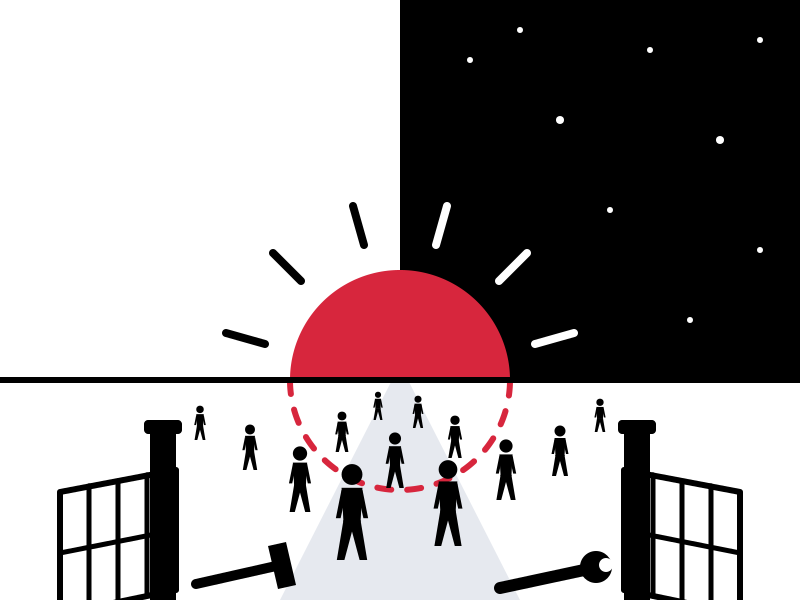
The March equinox: day and night are the same length across the whole planet. It is the date lastday.at sets for the end of the era when people had to work to live, and for the start of universal income. Keynes gave it one hundred years in 1930; we are betting on this day.
Forecast: lastday.at.
Countdown to March 20, 2030
Illustration: lastday.at. This photo has not been taken yet.